
Florida vehicle registration budget for employee relocations
Estimate title, plate, registration and any applicable use tax separately for each car. Give the relocating household a dated budget that shows pending assumptions, and reconcile eligible outlays against the itemized receipts under your existing relocation policy.
Build a Florida registration estimate
Give finance and the household three different numbers
An employee moving to Florida asks how much to set aside to bring two cars. Finance asks how much the company might pay. A tax collector will determine what is due for each vehicle when the resident provides the documents. Put three separate figures in your relocation file: the planning estimate, the amount authorized under your company’s policy and the amount shown on the final itemized receipts. People can read the approval without believing that a forecast is a bill or that every charge in the forecast will be covered.
Start the estimate with one row per vehicle, even when both cars are going to the same address. One owner may be eligible to use a prior Florida registration record while the other needs a new plate with the initial fee. One vehicle may have years of documented use out of state while another was recently purchased. A household-level flat estimate hides both decisions. Show finance which lines are expected and which are still dependent on an agency review, while telling the resident exactly why the figure could change.
The examples here concern ordinary passenger cars already being brought into Florida. An imported vehicle, company fleet, heavy truck or unusual title can have a different official route and fee schedule. A leased vehicle can require separate work with the lessor. Mark those rows for direct confirmation instead of using an ordinary-car amount as a stand-in. The relocation team’s registration checklist covers the client’s insurance, timing and appointment preparation. Use this budget guide to keep the figures and the approvals attached to that work.
Build a vehicle budget row another coordinator can rerun
Start with the Florida county of registration, the expected tax year and the resident’s ownership and title route. The county where a moving truck unloads or the tax collector office where someone has an appointment is not a substitute for the buyer’s registration address for the motor-vehicle surtax. Check the jurisdiction if a mailing city or ZIP straddles a county boundary. Choose the rate in effect for the transaction and revisit the estimate if delivery, office processing or paperwork pushes the case into a different year. A January arrival budget prepared in November deserves its own recheck.
Record the passenger vehicle’s documented empty weight range, whether a title is in hand or held by a lender or lessor, and whether the resident expects electronic or paper delivery of the Florida title. Note whether a previous Florida plate or registration record is reported, verified or unavailable. These can be concise categories. Your budgeting spreadsheet can track the existence of supporting evidence without carrying scans of titles, full VINs or names. The resident and the receiving office can handle the identifiers and supporting records through their approved channels.
Give every unresolved input a person and a review trigger. “Vehicle B: credit reported, resident to locate purchase invoice and ask county before appointment” is actionable. A blank cell could mean that the coordinator forgot to ask, the charge was zero, or a document is still missing. Using explicit values such as “confirmed,” “pending evidence” and “requires official review” helps a covering colleague pick up the case while distinguishing a known zero from a figure you cannot estimate yet.
| Budget field | What to record and verify |
|---|---|
| Vehicle label | A or B, linked to the protected household case record |
| Destination and timing | Registration county, expected year and estimate date |
| Vehicle and title | Empty weight band, ownership route, title custody and delivery option |
| Plate scenario | New plate, eligible prior record or confirmed transfer; verification owner |
| Tax facts | Purchase and prior-use evidence, taxable amount if needed, status of like tax paid |
| Budget | Base estimate, pending difference, authorized scope and final public receipts |
| Review | Source checked, action owner, next review date and resolved variance |
Separate title and registration from a first-plate charge
Use the FLHSMV rate chart to identify the annual passenger-car registration amount and the title and branch lines that fit the scenario. The chart distinguishes a standard metal plate from the initial registration fee. The quoted base can change with the vehicle’s weight, title delivery choice and applicable lien recording, even when the cars belong to the same household. Show the registration period assumed, and let the resident ask the actual office for any additional services, card processing or private agency charges before the visit.
The initial fee is especially important when you prepare an allowance. Florida’s initial registration procedure generally applies the $225 charge when there is no eligible prior Florida plate or plate record for the owner and no applicable exception. A resident may remember a plate from a previous move but be unsure whether the state record can be used. Budget the new-plate path while that is unresolved and list the lower scenario alongside it as conditional. Keep ownership, vehicle class and any required evidence tied to the county’s confirmation.
When a resident has a metal plate from another state, handle the old state’s return or disposal instructions separately. Possessing the metal does not establish a Florida plate record. Likewise, a Florida plate used by a different household member or still on a car in use should not be assumed available to another vehicle. A coordinator can communicate the estimated effect of each official outcome without making a registration decision for the household.

Leave use tax open until the supporting evidence is available
Older ownership and a recent out-of-state purchase can raise very different budgeting questions. The Florida Department of Revenue describes a presumption for a vehicle used for at least six months outside Florida in another state, the District of Columbia or a U.S. territory before coming into Florida. The vehicle owner needs records supporting prior use. Ask the resident about actual use and enter the no-use-tax scenario when that evidence supports it. A purchase date alone does not establish where the vehicle was used. If the record is unclear, have the resident ask the tax collector or revenue department how to demonstrate the timeline.
For a recent purchase requiring a use-tax estimate, identify the taxable amount and report documented tax paid in the other jurisdiction separately. The DOR guidance allows a qualifying credit for like tax lawfully imposed and paid. A receipt that includes another state’s registration costs and taxes on one line needs clarification before a credit is entered. Have the resident ask the receiving office which amount it accepts. Show the before-credit figure in a budget or give two figures with a written condition. This lets a family prepare for an appointment before a credit is verified without losing the potential saving.
Review the Florida state rate and the rate for the registration county. For a standard motor-vehicle transaction, discretionary surtax applies to the first $5,000 of the taxable sale amount, separate from the state calculation. Use the official rate publication for the transaction year. If you have enough information to calculate possible use tax but the office needs evidence to confirm the credit or presumption, identify the extra amount in the finance note and the document that could remove it. Direct the employee to the six-month vehicle use tax guide for a practical look at those records.
Reproduce a two-car Miami-Dade budget
Consider a household moving to Miami-Dade in 2026 with two out-of-state passenger cars in the 2,500 to 3,499 pound empty-weight group. Both owners are bringing title evidence, using standard plates and electronic title delivery, and the budget assumes one year of registration and includes the calculator’s standard county branch fees. Assume no new lien recording, specialty plate, late title charge or additional office services. This is a sample from the estimate, before any office has determined what is due. Choose the moving path and Miami-Dade for each vehicle, and keep the scenarios aligned on these shared inputs.
Vehicle A has documentation of more than six months of out-of-state use and starts with no verified Florida plate record. With the new plate path, the estimate is $374.85: $35.60 of annual registration, $85.25 for an out-of-state vehicle title, $28 for new metal, $225 for the initial registration fee and $1 for standard branch charges. If the county later confirms the owner's prior Florida record is eligible and a new metal plate is to be issued, the calculator’s prior-record scenario is $149.85 using the other same assumptions. Save that reduction as a possible adjustment, without assigning the prior record to another car or owner.
Vehicle B was purchased recently, and the example assumes an accepted taxable amount of $4,000. Select the same standard new-plate fee options, enter $4,000 and leave the tax-paid field blank or at zero until the receipt can be reviewed. The 2026 example uses 6% state use tax and Miami-Dade’s 1% surtax. This is $240 plus $40, or $280, because the taxable amount is below the county surtax cap. The estimated total before a credit is $654.85. If the office confirms $160 of qualifying prior tax, entering that documented amount lowers Vehicle B’s estimate to $494.85. Run each case by changing only the single assumption you mean to test.
The combined working estimate is $1,029.70 before either pending adjustment. Confirmation of Vehicle B’s credit alone brings it to $869.70. Confirmation of both Vehicle B’s credit and Vehicle A’s eligible prior plate record brings it to $644.70, assuming the other fee lines remain unchanged. Preserve both the base version and the revised version, together with the dates of the two confirmations. This lets the next coordinator explain a $385 difference as two decisions instead of reporting that “county fees came back lower.”
| Miami-Dade scenario | Vehicle A | Vehicle B | Household estimate |
|---|---|---|---|
| New plates and no prior tax credit counted | $374.85 | $654.85 | $1,029.70 |
| Prior tax credit verified only | $374.85 | $494.85 | $869.70 |
| Credit and eligible prior Florida record verified | $149.85 | $494.85 | $644.70 |
Write the allowance with an eligible scope and a review rule
The person administering your organization’s policy decides whether the employer provides a fixed allowance, reimburses documented expenses within a limit, or follows some other process. Keep that decision outside the calculator. Send the planning numbers to the policy owner with the vehicle count, the charges included and the assumptions that have yet to be verified. For a fixed payment, make clear what the approved amount covers under the existing policy. For a reimbursement, state any actual expense categories the policy covers, required proof, the review channel and who can approve an exception.
Useful approval language is specific without overpromising. For example: “We estimated title, standard plate, registration and possible vehicle use tax for two passenger cars in Miami-Dade. The estimated amount may change when the office checks the prior Florida plate record and tax receipt. For the categories covered by your relocation policy, submit the itemized public receipts to the approved expense system. Ask your coordinator about charges outside the approved scope before relying on coverage.” Insert the policy’s real categories rather than copying all four fee categories into an authorization by default.
Keep vehicle shipping, insurance premiums, statutory registration charges and optional delivery or private service costs in separate budget lines. Two may be payable on the same day or appear on the same provider statement while having different approval rules. The person approving expenses should understand which costs the government collector actually charged and which come from another provider. If the resident needs to pay personally and seek reimbursement, describe that sequence under the existing policy so the family can prepare funds for the appointment without mistaking the estimate for an immediate payment from the employer.
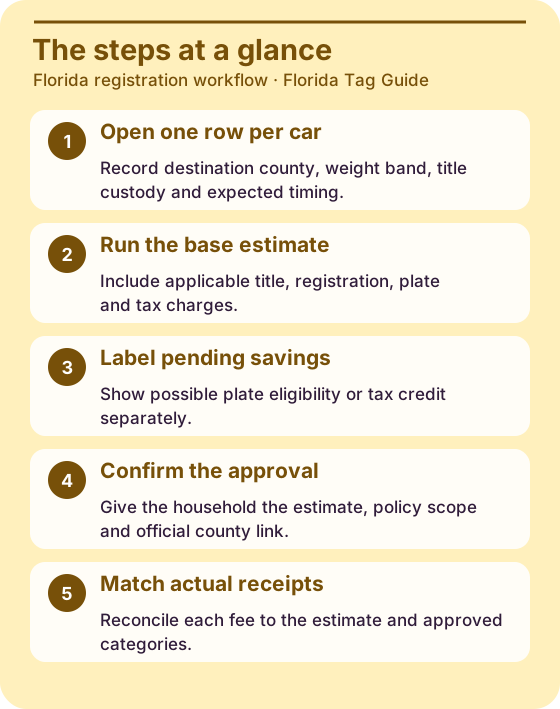
Read the steps as text
- Open one row per car Record destination county, weight band, title custody and expected timing.
- Run the base estimate Include applicable title, registration, plate and tax charges.
- Label pending savings Show possible plate eligibility or tax credit separately.
- Confirm the approval Give the household the estimate, policy scope and official county link.
- Match actual receipts Reconcile each fee to the estimate and approved categories.
Recheck the estimate before the office visit
Use a scheduled review close to the visit. Check whether the destination county changed, whether the vehicle is accessible for requested verification and whether the resident has Florida insurance and the ownership evidence for the applicable route. For a lender-held title, confirm the official step that is actually available before promising one combined transaction. A registration can be part of a process that still has title work pending. The financed car registration guide explains how to work with the lender and the county when the title has not arrived.
If the vehicle is arriving on a carrier, confirm that delivery, VIN verification and the appointment are in a workable order. Keep carrier charges and changes on their own row. A transport delivery does not establish the residency date or resolve the tax treatment of the vehicle. The auto transport registration handoff gives coordinators a way to manage the carrier and resident responsibilities alongside the estimate. Split the appointment and expense tracking when a two-car household has different delivery dates or two separate title paths.
Share the revised per-car figures and the official county link. Point out any limits on the estimate, such as a special plate request or a lien still being processed. Finish the handoff with the next question the resident should ask at the counter: for example, “Can you verify whether the prior Florida record applies to Vehicle A?” A narrow question turns a general estimate into an activity that resolves the household budget. If an unknown cost is significant enough to affect the organization’s authorization, send the revision to its policy owner before the client relies on the earlier figure.
- Recheck the registration county and rate year.
- Ask the resident to verify title custody, plate eligibility and tax evidence.
- Update the household forecast and share the official county instructions.
Reconcile the receipt by charge instead of comparing totals
After the visit, compare the county or authorized provider’s itemized receipt with the most recent estimate for that vehicle. Identify title, annual registration, metal plate, initial registration, use tax and credits on the actual transaction. One official receipt may contain a private service or a payment fee you had not estimated, while a second receipt may cover a follow-up visit or later title issuance. Record the charged amounts once and compare them against the scope finance authorized. Leave any expense classification or payroll decision with the appropriate internal owner.
A variance is useful when it names the actual change. Examples include “eligible plate record confirmed,” “prior tax credit accepted,” “paid for expedited title at customer request,” or “applicable fees split across two visits.” Map those explanations to the recipient’s proof or the official response. If the receipt and known transaction differ, ask the resident or the receiving office for clarification through the proper channel. One end-of-month line called “DMV difference” makes it hard to fix intake questions or detect duplicated charges.
Retain the authorized estimate version, the approved reimbursement amount and the receipt in the system your policy already specifies. Give the coordinator an internal case reference and the disposition of open expenses. Resolve the vehicle’s remaining registration or title tasks separately. Receiving a reimbursement for a first visit is an accounting result, and the resident may still need to follow up with an agency or lender. Let the client know which status you are referring to when you say a case is closed.

Use each relocation to improve the next estimate
At a regular review, look for a pattern in the differences attributed to vehicle type, county, plate, credit or office choices. If recently purchased cars often lack usable tax receipts, add a specific evidence question to the intake. If an estimated lien line becomes separate work with a lender, show that dependency early. If the same county’s rates changed, update the source reference in your planning material and check pending households that may be affected. Keep the identity information and supporting records out of the examples used to train new staff.
The repeatable step is an estimate somebody else can recreate. Bookmark the calculator beside your standard intake. Record a single dated row per car and save any conditions with it. Give the client the official link and a short summary of which assumptions to resolve. Reconcile what was charged to the approved categories. When the next two-car household calls, the coordinator can use the same structure with different facts and provide a coherent estimate before any title or plate paperwork is filed.
Frequently asked questions
What should we include in an employee’s Florida vehicle registration budget?
Estimate title, annual registration, applicable plate and initial registration fees, and any vehicle use tax. Track optional services and independent moving costs separately. Check the county, title path and actual vehicle record before confirming a figure.
Can we use one estimate for a household with two cars?
Add one dated estimate per car to get a household total. Ownership, plate records, taxable purchases and title handling may differ even when the cars arrive at the same address.
How do we budget for an unverified Florida plate record or tax credit?
Show the estimate before the reduction and a conditional alternative. Record what the resident needs to verify and update the budget when the receiving agency confirms the result.
Does the calculator determine what the employer reimburses?
The calculator estimates supported vehicle charges. The organization’s policy owner determines the reimbursement scope and evidence, and official receipts establish the amounts paid.
How should we handle a move spanning two calendar years?
Recheck the effective county rate and other applicable amounts for the transaction when you confirm the appointment. Keep the estimate date and assumed year visible on the earlier budget.
Official sources
- FLHSMV license plate rate chart and registration fee worksheet
- Florida Statutes § 320.072 on the initial registration fee
- FLHSMV procedure for previous Florida plate records and initial fees
- Florida DOR 2026 guidance on prior vehicle use and out-of-state sales tax credit
- Florida DOR 2026 county surtax schedule
- Florida DOR county rate lookup and discretionary surtax cap
- Miami-Dade Tax Collector title, registration and tax fee calculators
- Miami-Dade Tax Collector new-resident requirements and lienholder instructions