
How to register a financed car when you move to Florida
Ask your Florida tax collector where your lender should send the out-of-state title, then contact the lender’s title department. Get Florida insurance, gather your current registration and arrange VIN verification. If the lender cannot send the title in time or refuses to send it, ask the county what documentation it accepts for an out-of-state lienholder registration.
Estimate costs for the car you already own
Find out who has the title
Start with the vehicle registration from your old state and any title document you already have. The registration shows who has the vehicle registered and how long the registration is valid. The title is the ownership record. If you financed the purchase, you may be the owner on that record while the bank or credit union is listed as the lienholder. Depending on the issuing state and its process, you may have a paper title showing the lien, the lender may hold the paper, or the record may be electronic. Your monthly statement can help identify the loan servicer, but it does not tell you which of those three situations applies.
If the car is leased, the leasing company generally holds ownership. Start with its relocation department and ask when it can provide the title, lease paperwork and any authorization needed for the person who will visit the Florida office. Moving your own financed vehicle and moving a leased car can look identical in a parking lot, yet the signatures and supporting documents differ. Check the names on your documents early. If a parent and adult child are co-owners, for example, the person who pays the monthly bill may still need the other owner’s participation. Take a note of each name, the issuing state and whether you can physically produce an original.
| What you have | Who to contact first | Question to ask |
|---|---|---|
| Paper title showing a lien | Florida county office | Can you process this original and record the existing lien? |
| Registration, with lender holding title | County, then lender title department | Where and how should the lender send the title? |
| Lease paperwork and registration | Lessor’s title or relocation department | Which authorization do you provide for this county? |
| Payoff confirmation, but no title | Former lender and issuing state | Has the lien been released in the title record? |
Get the receiving instructions before the bank sends anything
Find the tax collector or motor vehicle service center that will handle your transaction. Use its published out-of-state title instructions, then ask for the address or department that receives titles sent by lenders. The county’s public mailing address and its title intake address can differ. Tell the county that ownership is staying the same and that a lien is active. Ask whether it wants the lender to mail an original directly, whether it has a request letter, and how you can check that the title arrived before you travel to the office. If it issues a reference or asks you to include an identifier, give that to the lender through an official channel.
For example, Palm Beach County provides letters to help owners request lender authorization. Orange County publishes a list of lender information for customers whose titles are held by a bank. Hillsborough County links to its own existing-lien instructions. Treat those pages as examples of how a county handles the transaction. If a friend had a document accepted in one county and you have an appointment in another, the receiving office is the right place to verify what it wants and which locations do the work. Save its reply and keep it with the lender’s case reference.
Open a relocation request with the lender
Use the customer service number on your legitimate loan statement or the lender’s authenticated website. Ask to speak with the title or interstate relocation team. Give the lender the destination Florida county, the intake instructions it requested and the information it requires to match your account. Explain that you are moving and want to change the title jurisdiction while keeping the loan in place. A title request to record an existing lien in Florida is a different conversation from asking a lender to release that lien because the debt is paid. Confusing the two can send the case to the wrong department.
Ask the representative to confirm the title format, which party holds it and what the lender can send. If a lender cannot or will not deliver the title, ask whether it can provide its written position or respond to the county’s official request. A useful reply identifies the vehicle and describes who holds the title and what the lender will provide. Ask when you should follow up and whether the bank has a tracking or case number. Keep those notes in your own records. Use the secure channel the lender or county directs you to for documents containing the loan account number.
- Ask whether the case is being handled by the title department or a general address-change team.
- Confirm the lender’s mailing address and the contact method the county requests.
- Give the lender the office’s reference or delivery information before a package is sent.
- Ask how you will know that the vehicle can move from a pending file to a Florida title.

Understand what happens when the original title is pending
There are two outcomes worth asking about at the counter. With the necessary title documents in hand, the county can review the application to title and register the car in Florida with the lien recorded as appropriate. When an out-of-state lender or lessor is still holding the title, FLHSMV guidance describes circumstances in which the agency may issue a registration while it waits on the ownership documents. The procedure identifies different reason codes for an out-of-state lender and for a lessor with documents pending. A registration in either situation gives you a record of what the office approved. Keep following up on the Florida title if it remains outstanding.
Florida Form HSMV 83060 addresses a vehicle with an out-of-state title and lien. It refers to applying for a Florida title at registration or producing proof of a lender’s refusal to release the title to Florida for titling. The distinction matters in a real conversation. A bank may decline to mail an original to you personally and still agree to deliver it to an agency. Clarify which answer the bank gave before treating it as a refusal. Ask your office to review the available evidence and give you the next step. A registration card from your old state, an insurance card and a verbal statement about the bank do not automatically qualify a file.
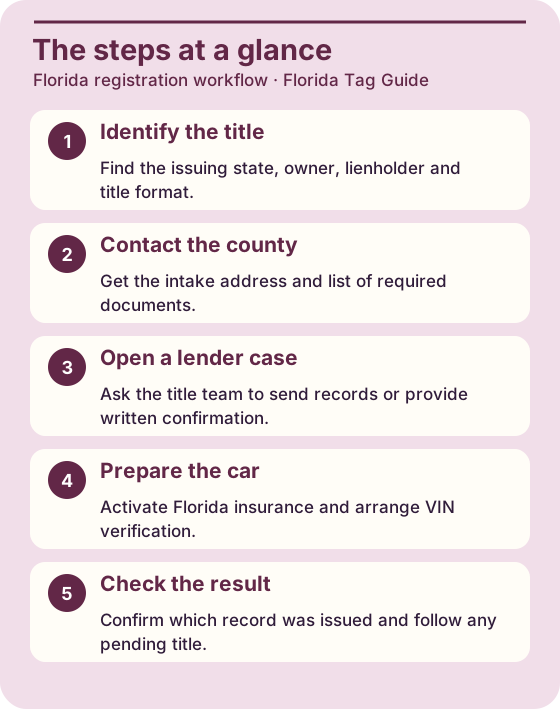
Read the steps as text
- Identify the title Find the issuing state, owner, lienholder and title format.
- Contact the county Get the intake address and list of required documents.
- Open a lender case Ask the title team to send records or provide written confirmation.
- Prepare the car Activate Florida insurance and arrange VIN verification.
- Check the result Confirm which record was issued and follow any pending title.
Set up Florida insurance using the exact vehicle details
Talk to an insurer authorized in Florida and give the actual Florida address where the vehicle will be kept. Confirm your VIN from the car and your records before the policy is issued. Ask the insurer to provide Florida proof of coverage effective in time for registration, and coordinate the date with the requirements of your former state so there is no coverage gap. Having insurance through a national company is common. A card for a policy written for your old state may still be the wrong evidence for a Florida registration.
The county checks the proof of Florida coverage. A lender may also require coverage to protect the car’s value under the loan agreement. Check any comprehensive and collision requirements, deductible limits and how the lender should be listed before switching carriers. The paperwork for one purpose may be different from the paperwork for the other. When a company emails a quote with a price and a date, ask when the coverage is actually bound and when its insurance card for the vehicle will be ready. Save a copy or have the carrier’s app available at the office. If the VIN or effective date is wrong, let the insurer correct it directly instead of editing the document.
Arrange VIN and odometer verification
The county normally needs to verify the identity of a used vehicle coming from another state. Your office may be able to perform the check at the appointment if you bring the car and its location offers the service. When bringing the car is impractical, ask about HSMV 82042 and the authorized verifier options described on the form. Confirm the office’s requirements for a completed original, especially if verification takes place while the car is still in your old state. A phone photo helps you compare the VIN with your card, but it does not perform an official physical verification.
Think through transport when the loan and title are creating a delay. A car that was shipped to a storage facility, parked with a relative or left at a mechanic may be unavailable when you booked the appointment. First check whether the vehicle can lawfully be driven. Then ask whether you can change the appointment, use an authorized verifier where the car is, or arrange transport. A VIN character that differs between title and registration is worth resolving before you take any of those steps. The county can tell you which agency has to correct the record, and your lender can tell you whether it will need revised paperwork.
Prepare a folder and an estimate for the actual transaction
Put the older registration, valid identification for the people who need to sign, Florida insurance proof and the title paperwork or lender correspondence in a single folder. The county may request an application for motor vehicle title, evidence of purchase or tax paid if that question applies, and the verification form depending on how the inspection is being handled. Confirm any requirements for an absent co-owner with the county before using a power of attorney. If you already have an eligible Florida plate or registration history, collect the proof that lets the office check whether it can apply it in your case.
Set aside money for the applicable title, plate and registration items, with room for office or delivery charges. A tax question can come up if the car was recently purchased or if you cannot show when and where it was used. Bring any relevant invoice and state registration history rather than assuming a tax credit will post automatically. Open the calculator, select the moving scenario and use your county, vehicle details and plate situation. For an active loan, the result is still an estimate for the ordinary vehicle fees. The county confirms the charge for your particular title status and tells you whether a later visit or a separate payment may be needed.

Two examples with different lender responses
In Orange County, an owner moves with a sedan that they have financed for two years. The old registration is current and the bank confirms it holds a paper title. The owner asks the county where the original should go and submits that location to the bank’s title team. They bind Florida insurance and ask the office about bringing the car for VIN verification. A few days before the visit, the owner checks delivery and confirms that the packet is linked to the transaction. If the county has what it needs, the owner can ask to complete title and registration at the same appointment.
In a second example, a borrower moves to Tampa with a car whose state title record is electronic. The lender’s call center says it cannot release a paper title to the owner. The borrower calls the title team to find out whether the lender can respond to the agency or request documentation from the issuing state. They bring current registration and the lender details Hillsborough asks for and request a review of the possible pending-title process. If the agency authorizes registration, the borrower writes down what remains open. If the office asks for more evidence, they leave with a specific list of what to collect. Getting the plates and completing the new title can be two different dates.
Check the plate, title status and address after the visit
Before leaving the office, read the receipt, title application copy and new registration if one was issued. Match the plate number, VIN, owner names and address. Ask whether a title record was completed or the application remains pending. Save the copy with your registration and track where the lender should receive its notice. For an electronic Florida title, a paper envelope might never be the expected result. The county or FLHSMV can explain how to learn whether the title is on record and whether the lienholder is correctly recorded.
Your former state may have its own instruction for plates, registration and insurance when the car leaves its jurisdiction. Check directly with that motor vehicle agency, especially before changing coverage or discarding a plate. When a lender case stays open, follow up with its title department using the case number. A new Florida address on your payment statement is separate from the location on your registration. Review both. If you later move within Florida while title paperwork is pending, tell the office and the lender how to reach you and update the live registration address through the official process rather than relying on mail forwarding.
Questions that prevent a second trip
When an appointment comes too early in the process, take advantage of the time to confirm one or two precise details with the county. Ask whether lender papers must have arrived before your visit and whether the selected office can verify the car’s VIN onsite. Ask what that location accepts if the lender refuses to release the original and how the office handles the registration while it reviews the title. If the loan is nearly paid off, ask whether a recorded satisfaction or a new title from the issuing state changes the documents you should bring. The timing of a final payment and the timing of the release may be different.
If the old registration will expire soon, tell the office that date. Ask which legal options exist for your vehicle and whether you should arrange transport instead of driving it to the appointment. A booked visit, a printed cost estimate and a package tracking notification have administrative value. None is a registration or driving permit. Once you know the status, use your estimate to plan the payment, the county’s instructions to plan the visit and the lender’s case number to finish any outstanding title work.
Frequently asked questions
Do I have to pay off the loan to title a car in Florida?
An active lien can generally be recorded on the Florida title. Work with the lender and county to get the required ownership evidence. Check any loan-specific relocation requirements with your lender.
Can I register the car before the lender sends the title?
FLHSMV describes a pending-title process for certain out-of-state lender or lessor cases. Your county must review the circumstances and supporting evidence before issuing a registration.
What if the lender will send the title to the county but not to me?
Get the exact receiving address and case reference from the county. Ask the lender to send it directly there and verify that it has arrived before relying on your appointment.
Can a bank statement replace my out-of-state registration or title?
A statement may identify the loan or servicer. Use the documents your county specifically requests to establish the registration, ownership and title status.
Do I have to carry a paper Florida title after it is issued?
Florida uses electronic title records as well as paper titles. Check with the office which form was issued, whom the record lists and what documentation to carry when driving.
Official sources
- Miami-Dade Tax Collector: registration for new Florida residents
- Orange County Tax Collector: out-of-state titles and cars with loans
- Hillsborough County Tax Collector: title transfer and VIN verification
- Palm Beach County Tax Collector: title services and lienholder letters
- FLHSMV notice INFO23-026: title documents pending with a lender or lessor
- FLHSMV Form 83060: out-of-state title and lien
- FLHSMV Form 82042: VIN and odometer verification
- Florida Statutes § 319.21: Florida title requirements
- Florida Statutes § 320.02: vehicle registration