
Florida auto transport and registration handoff for relocation teams
Track the car, the ownership documents and the person who can sign on separate timelines. Confirm where the vehicle can wait, who can release it, how the VIN will be verified and when the county can see the required people and documents.
Prepare the Florida registration visit
Put three dates on every vehicle move
A car can reach the destination several days before its owner, while the original title is still in a lender’s office. The reverse can happen when an employee starts work before the carrier collects the car. A simple move date in a customer record will not show either gap. Record the vehicle’s estimated arrival window, the date the owner or county-approved signer can attend, and the date the original ownership evidence is expected to be available. Keep the date of the latest confirmation beside each entry so the team can see which dates are firm and which are estimates.
Use each row of the relocation file for one vehicle. Two cars in a household can have different carrier schedules, title holders, co-owners and insurance arrangements. Give each record a case reference that staff can use without forwarding identification or an entire title image. Keep the full VIN and case documents in the system approved for customer records. For the shared scheduling view, show only the details needed to identify the vehicle and its next dependency. Assign one coordinator to follow through when a delivery, title or appointment changes.
| Timeline | Who confirms it | What to record |
|---|---|---|
| Vehicle | Carrier and receiving contact | Delivery window, legal storage location and key release plan |
| Person | Owner and receiving county | Arrival, signer availability and any required authorization |
| Paperwork | Title holder and receiving county | Custodian, accepted documents and expected receipt |
Agree on delivery and custody before the car ships
Ask the customer who booked the transport and whether the business they are dealing with will carry the vehicle or arrange transport with a separate carrier. FMCSA explains both roles and provides a way to check interstate operating authority. Record the actual carrier’s name once assigned. Confirm which contact will provide updates, who can accept delivery, and whether the contract allows delivery to a different address when access changes. An apartment drive, a gated community and a receiving lot may each have different restrictions for the carrier vehicle. Confirm the location and receiving hours directly.
Give the carrier only the access and vehicle information needed for the contracted work. Decide which key or access credential it needs and who keeps a spare. Ask how any digital or remote access will work if a phone is unavailable. Keep registration paperwork needed for identification and the customer’s original ownership file under the control of the agreed custodians. Confirm what the carrier actually requires in advance. If the owner will be unavailable, name the recipient authorized under the carrier’s terms and record what proof the carrier requires from that person before releasing the car.
- Ready when the carrier, receiving contact, delivery hours and key plan are confirmed.
- Wait when the destination cannot take the carrier, the authorized recipient is not available or the plan relies on an unconfirmed subcontractor.

Receive a car that arrives before the customer
Set up permission for delivery onto lawful private property or into an agreed storage facility. Verify the destination accepts the vehicle’s condition and can accommodate the carrier’s unloading method. Get written terms for after-hours drop-off, storage charges, access and release from the provider. The receiving person should know the expected window, who may sign the delivery record, how to document the condition at delivery and where the keys will be secured. Keep the customer informed if the carrier changes its estimate or the facility cannot accept the car during the new window.
An accepted delivery means the car is in custody at the agreed location. Before anyone plans to drive it from there, have the owner confirm valid road registration and insurance for the intended use and driver. Ask the county if the car is being brought into Florida and the owner’s registration obligation is unclear. If it cannot be driven legitimately, arrange lawful transport or an inspection where it sits if the agency accepts that approach. Confirm whether the site permits an authorized verifier to inspect the vehicle and whether the owner needs to attend. Those permissions should be arranged before the customer arrives.
Use the waiting period when the customer arrives first
Collect the destination county, expected first date of Florida road use, title state, owner names and any lender or lessor details the county needs. Use the waiting period to identify the correct vehicle service, obtain the insurer’s timing instructions and ask the county about an inspection at the branch or acceptance of verification performed in advance. If the car is still accessible in the sending state, the owner may be able to arrange verification there with an authorized officer, subject to the receiving office’s instructions and the title facts. The owner and verifier should follow the actual form and inspection procedure.
When the owner begins Florida employment or enrolls a child in public school, look up the registration timing early. Florida Statutes 320.38 sets a ten-day rule for applicable vehicles proposed for Florida road use in the employment or public school circumstances it covers. County residency checklists can frame registration timing differently. For coordination, plan early and confirm the applicable dates and facts with the destination office. A shipment delay, an open title request or a booked appointment should be recorded as a reason to call the county. Ask the agency how it wants the resident to proceed and keep the vehicle off public roads when authorization is uncertain.
- Ready to plan the visit when the county confirms the service and the vehicle inspection path.
- Wait to rely on a booking until the arrival window and all required documents are confirmed, or the branch says the visit can proceed while an item is pending.
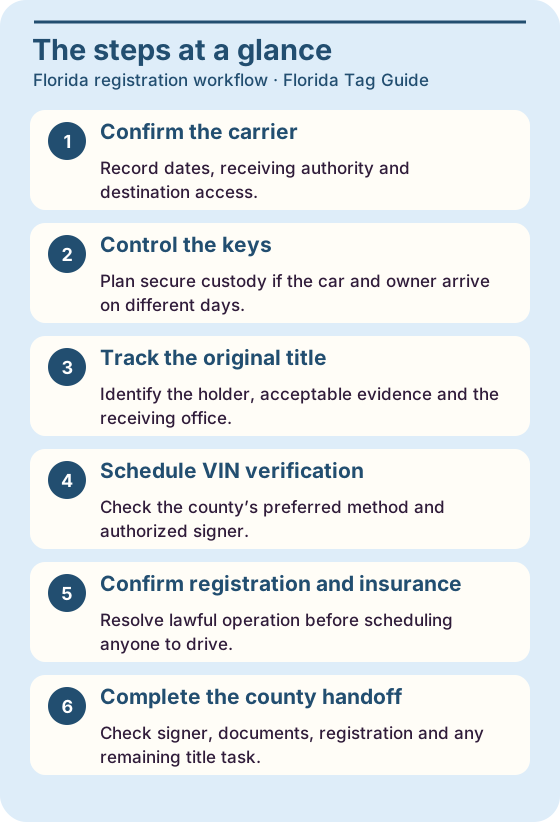
Read the steps as text
- Confirm the carrier Record dates, receiving authority and destination access.
- Control the keys Plan secure custody if the car and owner arrive on different days.
- Track the original title Identify the holder, acceptable evidence and the receiving office.
- Schedule VIN verification Check the county’s preferred method and authorized signer.
- Confirm registration and insurance Resolve lawful operation before scheduling anyone to drive.
- Complete the county handoff Check signer, documents, registration and any remaining title task.
Specify who holds and who receives the original title
For a paper title the owner holds, have the owner confirm where the original is and who will present it. Store or transfer it separately from the travel key and the carrier’s delivery paperwork. A copy can help catch name and VIN errors in the planning stage. Establish beforehand what original or official ownership evidence the office accepts for the actual transaction. If a separate document shipment is needed, the owner should arrange it through an agreed channel and retain confirmation of sender, recipient and delivery. Keep account numbers and full document images out of general progress messages.
If a lender or lessor holds the title, ask the receiving office where it wants the lender or lessor to send it and how to identify the intended branch or case. Request a confirmation showing when and where the documents were sent. FLHSMV has a procedure for registration while an eligible out-of-state lender or lessor provides title evidence. Have the county determine whether that route is available and what it needs. Keep the file open for the final title even if the agency can issue registration while it waits. For leased vehicles, use the leased-car relocation guide for questions about the lessor’s authority and documents.
| Title scenario | Ready | Wait or clarify |
|---|---|---|
| Owner holds original | Original identified, required signer available | Only a copy is available or names do not match |
| Out-of-state lender | Destination office confirms what it accepts and where to send it | Title request has no recipient or status is unknown |
| Out-of-state lessor | Lessor and county confirm the acceptable packet and authority | Only the carrier authorization or payment record is available |
Plan an authorized VIN verification
Florida normally needs physical VIN verification for a used motor vehicle being titled in the state for the first time. Start with the title history. The applicable form and TL-10 procedure identify authorized roles, including specified law enforcement, Florida notaries, licensed Florida dealers and eligible agency personnel. The carrier’s delivery condition report may identify the correct vehicle so it can be matched to the move record. For title purposes, assign the separate VIN task to an authorized verifier and coordinate physical access. HSMV 82042 calls for relevant owner information and a physical inspection for its ordinary verification section.
Ask the branch whether it will inspect the car at the appointment or accepts verification completed beforehand on HSMV 82042 or the applicable title form. Tell the owner who will have the keys and whether the owner must be present. Confirm that someone can reach the VIN locations and have the actual ownership documents available to compare if required. If the VIN differs between the labels, title or insurance record, treat it as an unresolved document issue. Ask the receiving office what evidence or correction it needs. The Florida VIN verification guide explains the ordinary form options and how the owner can prepare.
- Ready when the inspection method and signer are confirmed for the county.
- Wait when the car is inaccessible, the verifier has not agreed to the job or the vehicle identifiers disagree.
Separate the carrier delivery date from lawful road use
Ask the owner to confirm three things directly with their insurer and the relevant registration authorities. First, what coverage and registration are in force while the car is in transit or stored. Second, what must be in place for the first person who will operate the car after delivery. Third, when Florida insurance evidence will be available for registration. Record the effective dates and the fact of confirmation so your team can coordinate dates without interpreting a policy. The insurer and agency can explain the details if the car has an expiring tag, a plate from a prior vehicle or a gap between departure and arrival.
Do not schedule a trip from the storage lot to the tax collector on the assumption that a current-looking plate or recent insurance quote covers the trip. Ask the owner to resolve uncertainty with the appropriate issuer first. The sending state can tell the owner when to surrender or retire its plate and how to avoid a lapse under that state’s rules. For Florida registration, Florida insurance proof is ordinarily required. The team can keep the appointment status visible and help coordinate an appropriately authorized carrier, on-site verification or storage as agreed with the owner while the documents catch up.
Book the right county service at the right time
Use the owner’s county of residence and choose a branch that handles first Florida titles and registration. Check whether it can do a VIN inspection, which appointment type to choose and which parties must attend. Orange County, for example, identifies the owner and co-owner attendance or original authorization it accepts and asks clients to bring the car for verification. Another office may give different practical directions. If the owner plans to authorize another signer, confirm the specific form and original that the office requires for this transaction. Authority to receive a car at a terminal serves a different purpose from title signing authority.
Reserve an appointment once the branch confirms what it expects and the required people, original paperwork, insurance proof and verification can reasonably be present or accepted. Choose a flexible booking if your process allows it and the carrier window is uncertain. Add a check-in before the branch’s cancellation or rescheduling cutoff. At that check-in, compare the account with the latest carrier and title confirmations. If the schedule is compressed, ask the office for its instructions before changing the date and tell the resident which item is outstanding. Use the new-resident vehicle visit planner to collect the county link and make a checklist.
| Appointment dependency | Ready | Wait or ask the branch |
|---|---|---|
| Location and service | First Florida title service and inspection method confirmed | Only a driver license or renewal reservation appears |
| Owner or signer | Required parties and any accepted original authority available | Only a delivery release or verbal authorization exists |
| Vehicle and title | Vehicle access or accepted verification plus accepted ownership evidence | Delivery estimate overlaps appointment or originals are pending |
Handle a car delivered to Orlando before its owner flies in
A relocation team is preparing an employee’s move from Illinois to Orange County. The car is expected on Tuesday. The employee arrives Thursday and starts work Monday. The Illinois title is held by a lender. Before the car moves, the team agrees with the employee and carrier on the receiving facility, authorized recipient and key custody. The facility confirms commercial unloading access and the hours for access and release. The employee asks the lender when the accepted title evidence can be sent and checks the receiving instructions with the county. The team puts each confirmation in the vehicle’s record.
On Tuesday, the recipient logs delivery and stores the key. An inspection appointment is contingent on how the branch will verify the car and whether Florida registration can proceed while the title is on its way. The employee contacts the insurer about coverage and the first day they intend to drive. If legal operation is unresolved by Thursday, the employee uses other transportation and asks about verification at the storage location or a lawful transport arrangement to the verifier. On Friday, the coordinator checks the title delivery status, the county’s required documents and the appointment date before confirming the employee’s plan.
If the county confirms a registration route while the lender sends the title, the employee keeps the agency receipt and follows the instructions for later title completion. If it cannot proceed, the team records the specific missing evidence and who is chasing it, then gives the employee a new check-in date. Use the relocation budget guide to separate the estimate from additional storage and transport charges. The relocation company checklist covers the other parts of the move.
Close delivery, road use and title as separate events
At handoff, ask the authorized customer contact to confirm where the car and all keys are, which documents were received, and which actions remain. Use three status entries if that helps the team keep responsibilities clear. Vehicle delivered can be marked when custody is confirmed. Registration ready can be updated once the owner has checked the actual accepted registration and effective coverage. Title complete can be recorded when the state has processed the title and any remaining lender or lessor task is accounted for. A pending title does not necessarily mean a registration is pending. The agency record and receipt explain the outcome.
Make the last message actionable for the resident. Confirm the appointment details or the exact item still due, who should send it and when the team will check back. If a package went to the wrong branch or the carrier delivered earlier than promised, update the corresponding contact and date rather than restarting the entire file. When the transaction closes, retain only the documents that belong in the agreed customer file and follow the business’s policy for retention. Leave a short status note so another coordinator can answer the next question without asking the owner to forward documents again.
Frequently asked questions
Can the car reach Florida before the person who owns it?
It can be received by a party authorized under the transport and storage terms. Arrange lawful storage, secure keys and document the delivery. Confirm separate requirements before anyone drives it or acts for the owner at the title office.
Can the auto transporter verify the VIN for the Florida title?
A transport document can identify the car for the shipment. Use one of the eligible roles and the physical verification method required by FLHSMV and accepted for the title application.
Should we book the county appointment before the car arrives?
You can plan it early. Check whether the branch wants to see the car, what ownership evidence it needs and which signers must attend. Choose a date with those requirements and the applicable registration timing in mind.
What if the car is here and the original title is still at the bank?
Ask the receiving county what evidence to bring and whether registration while the lender sends the title is available for that case. Track the expected title delivery separately even if the agency issues registration.
Can a delivery authorization be used to sign for the owner at the title office?
Ask the office which signers are required and which original authorization it accepts, if any. The person authorized to accept a shipment has a separate role.
Official sources
- FMCSA advisory on interstate auto carriers and brokers
- Florida Statutes 320.38 on registration after employment or public school enrollment
- Florida Statutes 320.02 on road use, registration and proof of insurance
- FLHSMV HSMV 82042 VIN and odometer verification form
- FLHSMV original title and VIN verification procedure TL-10
- FLHSMV notice on registration while out-of-state lenders or lessors send titles
- FLHSMV RS-36 insurance verification procedure
- Orange County Tax Collector residency dates and vehicle appointment requirements
- Miami-Dade Tax Collector new-resident title, insurance and verification instructions