
What counts as proof under Florida’s six-month vehicle use tax rule
Florida generally does not charge vehicle use tax when the current owner can document at least six months of qualifying use in another U.S. state, territory or Washington, D.C., before bringing the vehicle into Florida. If that test is not met, a qualifying tax already paid elsewhere may reduce what is due.
Compare the costs before your county visit
Identify the dates the county needs
Before estimating a Florida registration bill, write down when you acquired the car, when you began using it outside Florida and when it came into Florida. Add the state or territory where you used it and your name as it appears on the paperwork. Keep the date of the Florida title appointment separate. The Department of Revenue’s motor vehicle guidance measures qualifying use before the car was brought into the state. Waiting to make an appointment after moving will not add months of earlier out-of-state use.
The state treats qualifying use in another U.S. state, a U.S. territory or the District of Columbia for six months or longer as evidence that the vehicle was purchased for use outside Florida. FLHSMV’s tax procedure and the DOR refund instructions also address use under circumstances that would subject the vehicle to the other jurisdiction’s taxing authority. Consider the actual record for this owner and vehicle, including any gaps in use or a move through more than one place. If the timeline is borderline, ask the receiving office to review the facts rather than counting a rough number of days by memory.
| Date | Why it matters | Evidence to consider |
|---|---|---|
| Acquisition | Establishes when the current owner acquired the car | Title assignment, dated purchase invoice or sale agreement |
| Start of outside use | Helps measure qualifying use in that jurisdiction | Vehicle registration and supporting records |
| Entry into Florida | Separates prior use from later Florida use | Delivery confirmation or other dated move records |
Build a record that connects the owner, VIN and dates
Look first for prior registration in your name, the original or assigned title and purchase evidence that identifies the VIN. If the state issued more than one registration or you have a gap between documents, retrieve the record from its motor vehicle agency. Put the items in date order and check that they refer to the same owner and car. Name changes, co-owners and a lender’s name on the title are easier to explain when you show the correct supporting documents in the application rather than asking a clerk to infer the connection.
For missing dates, collect supporting records that indicate where and when the car was used. Examples might include dated insurance declarations, service records identifying the car or a transport receipt showing its move to Florida. Their value depends on how closely they connect the VIN, the owner and the relevant dates. Ask the office what it can accept. An invoice arriving by email years ago proves little about subsequent use on its own. If you have long registration coverage and recent vehicle service receipts from the same state, the two types of document may help explain different parts of the timeline.
Start requesting records early if your old state changed portals or only shows the latest registration period. Tell the agency the date range you need and ask whether it can issue a historical registration record. If two documents use different versions of your name, ask what evidence establishes that both belong to you. Review export and email settings before forwarding any record with your home address or financial details. Keep originals and send only the items an agency specifically requests through its official channel. A short index can make several years of paperwork easier to review, especially when a registration was replaced or the vehicle briefly changed plates.
- Request previous registration records if you only have the current one.
- Check whether older records show the vehicle identification number.
- Bring proof of any tax already paid in case the office needs to evaluate the credit separately.
Compare a clear case with a borderline one
A driver bought and registered a car in North Carolina in March of the previous year, used it there and brought it to Florida the following May. A North Carolina title in the driver’s name, registration covering the period and records from the move make the dates straightforward to present. The driver still needs to prepare for Florida title and registration. The use tax question can usually be evaluated from the record without treating the whole payment as a single number.
Now consider a driver who bought a vehicle on January 12, stored it for several weeks before it was used, and transported it to Florida in July. A comparison of the purchase and arrival dates alone may appear to cover six months. The records documenting actual use can tell a different story. Find evidence of the beginning of use and explain any gap. Another common fact pattern is a vehicle bought from a relative just before a move. The previous owner’s long history in the state does not establish six months of qualifying use by the person applying now. Ask the office how it will evaluate the ownership change and carry the purchase and tax records with you.
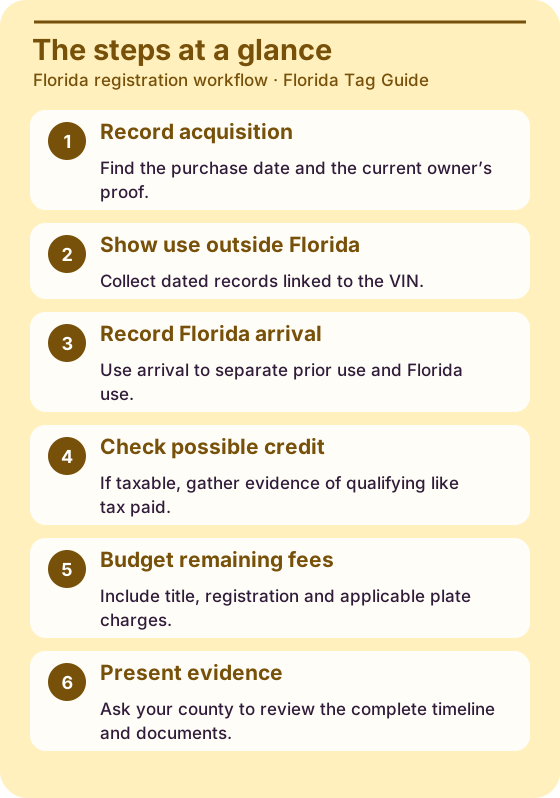
Read the steps as text
- Record acquisition Find the purchase date and the current owner’s proof.
- Show use outside Florida Collect dated records linked to the VIN.
- Record Florida arrival Use arrival to separate prior use and Florida use.
- Check possible credit If taxable, gather evidence of qualifying like tax paid.
- Budget remaining fees Include title, registration and applicable plate charges.
- Present evidence Ask your county to review the complete timeline and documents.
Check the credit when the six-month rule does not apply
For a vehicle that is subject to Florida use tax, start from the applicable Florida state amount and county surtax. A comparable tax lawfully imposed and paid in another U.S. state, a U.S. territory or the District of Columbia can qualify for credit. Current DOR vehicle guidance also describes a credit for like tax paid to an eligible local jurisdiction in another state. Your invoice should distinguish tax from title costs, registration, a temporary tag, dealer charges and shipping. If only a total appears on your invoice, request a line-item receipt that identifies the jurisdiction receiving the tax.
For a simplified $15,000 taxable purchase in a Florida county with 1% surtax on the first $5,000, the pre-credit calculation would be $900 statewide plus $50 in county surtax. With $700 in accepted like tax paid elsewhere, the illustrative difference would be $250. Compare that with a documented case that qualifies under the six-month rule. The use tax can come out at zero in either situation, but the paperwork needed to support each outcome is different. Use your actual taxable amount, applicable date and residence county in the vehicle sales and use tax calculator.
| Situation | What Florida reviews | Likely preparation |
|---|---|---|
| Six or more months of qualifying use | Ownership, location and pre-entry use | Records covering the required period |
| Shorter use and like tax paid | Florida tax and proof of allowable credit | Detailed paid tax receipt and Florida estimate |
| Shorter use with no accepted credit | Florida taxable amount and applicable county rate | Bill of sale or invoice and an estimate before the visit |

Separate use tax from registration and title fees
A zero use-tax outcome can coexist with a substantial amount due for title, registration and license plate services. Your county can explain which charges apply to the vehicle and owner. To plan the visit, organize an estimate around title and any lien-related charges, registration, plate issuance or transfer, applicable initial registration charges, and tax. Charges can also vary with the type of service or office. Keep a second version for a different plate scenario if you are unsure whether a Florida plate record is eligible.
After using the out-of-state registration planner, check the estimate against the county’s official checklist. A tool can show how selecting established qualifying prior use changes the tax line for a normal passenger car. The county evaluates your proof and processes the application. Leave yourself a budget margin if you are not sure which proof the office will accept. A final government receipt should let you identify the tax amount separately from the other charges, which is useful if you later need the Department of Revenue to review a payment.
- Keep your county, vehicle class and plate situation constant when comparing tax scenarios.
- Compare the tax line separately from the displayed total.
- Ask the office to show which part of the payment was sales or use tax.
Ask about leased, imported and military vehicles
A leased vehicle raises a different question because the user and registered owner may be different and Florida can tax lease payments. Ask the lessor and Florida office how to handle the title or registration and where payments are subject to tax. Keep the current lease and relevant statements available. A financed purchase also requires checking who holds the title. Even when the owner’s prior use supports the tax rule, the county still needs acceptable ownership evidence. Have the lender identify what it can send and how long it takes.
Use in a foreign country generally falls outside the ordinary six-month rule for use in a U.S. jurisdiction. Florida’s DOR consumer guidance and FLHSMV procedure describe a separate exception for a qualifying vehicle purchased and used abroad by an active member of the U.S. armed forces or their spouse. If that may apply, confirm the specific conditions and documentation with the agency handling the title. Keep customs, ownership and military records available as appropriate. Imported vehicles can also follow a different title and inspection workflow, so ask the receiving office about the vehicle’s origin before making the appointment.
Prepare a one-page timeline for the Florida appointment
Build a simple summary that lists the VIN, your name and contact details, the jurisdiction, date you acquired the car, start of documented use, and when it came into Florida. Add a short reference to the document supporting each date. Bring the underlying evidence in the format your title office accepts. Set tax documents behind the ownership and identification materials so you can pull them out without sorting the whole packet at the counter. If you have multiple cars, prepare a separate timeline and packet for each one.
Alongside the evidence of use, prepare Florida insurance proof, title documents and any necessary VIN verification. A first Florida title commonly involves a used vehicle identification check, so confirm whether the office can inspect the car or wants prior certification. Ask the county about scheduling and applicable deadlines before the vehicle comes into the state. A file that needs additional records does not give the owner extra time for the rest of the registration process. Keep a note of your conversations with the office so you can follow up with the right branch if something in the case changes.

Recover if you paid tax or the proof was incomplete
Ask the office which date or record it could not verify. If it needs an older registration or evidence of tax paid, request a copy from the original issuer. Keep the Florida receipt and appointment documents. If you believe tax was paid in error, the Florida Department of Revenue has refund instructions that specifically address vehicles owned and used in another state for six months or longer. Eligibility and the filing route depend on the circumstances and where you paid. Review the current form instructions and check which documents must come from the agency or seller that collected the payment.
Maintain separate copies of the Florida tax evidence and the evidence of earlier registration or tax payment. The DOR refund instructions describe documentation and, in some cases, an assignment form. A quote from a calculator is useful for understanding the category of the charge but cannot establish what you actually paid. When communicating with the issuing office, ask for a decision based on your documented dates and keep copies of what you submit. Try to close any gaps while the seller, insurer or registration office can still retrieve records from the transaction.
Tie the tax decision to the rest of your move
Prepare the papers before your insurance or registration changeover. For a household arriving with two vehicles, one car may have years of qualifying prior use while another was acquired shortly before the move. Run the estimates separately and make a checklist for each specific vehicle. Plan who can bring a car for verification and which person must appear on the title application. If a truck is carrying a vehicle on the move, save the itemized carrier delivery record and confirm where you can leave the car while waiting for the county.
Once you know what the office needs, book the appropriate vehicle title service and keep the evidence together. Record questions for the seller or prior tax agency as soon as possible. If you have only recently bought a car outside Florida specifically to bring it in, start with the interstate purchase guide for the title and travel handoff. For an existing household vehicle, the new-resident planner gives you an estimate and the official county link. Use that link to check the location and required documentation before booking.
Frequently asked questions
Do six months of ownership automatically remove the tax?
Florida looks for qualifying use outside the state by the current owner before the vehicle came into Florida. Prepare documents that establish the vehicle, owner, location and dates.
Can I wait until six months have passed to register?
The use period concerns the time before the vehicle entered Florida. State registration and title deadlines still apply to the facts of your move or purchase.
Does the rule apply to a car used in another country?
The ordinary rule concerns eligible U.S. jurisdictions. A separate exception can apply to qualifying military cases. Ask the agency about your evidence and import status.
Can I claim a credit using a purchase receipt?
An itemized receipt is helpful when it identifies a like tax actually imposed and paid to an eligible jurisdiction. The Florida office reviews what it can accept as proof.
Do I still pay title, plate and registration fees?
Yes, the use tax determination is separate from those charges. Run the registration estimate and confirm your transaction and amounts at the county office.
Official sources
- Florida Statutes 212.06 on uses outside Florida and like-tax credits
- Florida Department of Revenue motor vehicle use tax and out-of-state credits
- FLHSMV TL-08 vehicle tax procedure and documentary evidence
- Florida Department of Revenue consumer use tax questions
- Florida Department of Revenue refund instructions for tax paid in error
- Miami-Dade Tax Collector new-resident paperwork and deadlines