
Florida vehicle registration checklist for relocation teams
At intake, confirm the destination county, timing, ownership, lender or lessor and vehicle availability. Give each resident a dated checklist and a local estimate, then have them handle insurance, signatures and official filing with the proper parties.
Prepare a Florida arrival estimate
Add vehicle registration to the move plan before arrival
A resident who has packed their original title or left it with a lender may need a different appointment from someone who owns a car outright. A relocation team can catch that difference before moving day by adding a short vehicle interview to its standard checklist. Ask about the destination county, arrival and relevant work or school dates, where each vehicle is registered, who owns it and who can provide the ownership paperwork. Confirm which car will actually arrive first and whether the resident needs to keep driving in the meantime.
Give the client a dated handoff with the actions the client owns, the appropriate official link and the issues that require a call ahead. A checklist can be shared even when the resident is still selecting a final address, as long as it clearly distinguishes known facts from pending ones. Avoid recommending a specific office when the county or type of transaction is still unclear. The first useful deliverable is a plan for what to verify and when, with a specific person responsible for each step.
This process fits relocation coordinators, employee mobility teams, and businesses that onboard people relocating with ordinary privately owned passenger cars. A resident or authorized representative handles the formal application with the appropriate agency. Your team can help collect the right questions without signing, advising on legal status, obtaining credentials or taking payment for a government charge.
Record the dates that could change the deadline
Miami-Dade and Palm Beach give new residents a general 30-day registration timeline after establishing residency. Florida’s separate § 320.38 applies a 10-day rule to certain nonresidents who begin employment or education in the circumstances the statute specifies and plan to operate the vehicle on Florida roads. These have different triggers and populations. A coordinator should record facts and send time-sensitive or ambiguous situations to the tax collector or FLHSMV rather than deciding which rule applies for the resident.
Ask for the expected move milestone and any earlier event that might matter, including an upcoming work start, public school enrollment, or the end of out-of-state registration or coverage. Have the client discuss the real dates with the agency. Allow time for lender replies, physical verification and appointment availability rather than scheduling an appointment at the end of the general window. A resident who needs the car to report to work should know before the move if any insurance or registration evidence is still unresolved.
For example, one client moves permanently with their household and brings a vehicle with its paper title. Another starts work during a temporary stay and does not know when their family will move. The first may be able to prepare the standard new resident packet. The second needs to ask an official office about the shorter nonresident timeline and which documentation applies. Treat the second client’s case as a deadline question to resolve early rather than equating the work date with the later household move date.
Sort each car by who actually has the title
Put each vehicle into an ownership track: resident has an out-of-state title, lender holds the title, leased, or ownership or title format still unclear. A paid-off loan can still require a record update or proof. For a jointly owned vehicle, verify the identification and signers the receiving office needs before booking. If a legal owner will be unavailable, the resident can ask about accepted authority and documents. Do not have a family member sign a blank title in advance.
Miami-Dade directs a resident with a title held by an out-of-state lienholder to request title transfer using Form HSMV 83060. FLHSMV’s statewide notice describes circumstances where registration may be issued while a title from an out-of-state lender or lessor is pending. The agency determines which outcome is available and the actual evidence needed. Give the resident the lender contact task early and suggest they verify the destination county’s process, including where a document should be sent. A lender may respond directly to the office through that process.
For leased cars, ask the resident to involve their lessor and confirm its procedures for Florida insurance, title and signature authority. If the vehicle’s ownership record is electronic in the other state, determine what the receiving Florida office needs and which entity can provide it. Two clients with the same monthly payment arrangement can need different instructions because one is the owner with a lien and the other leases the vehicle. Keep that distinction clear in the financed car registration guide.
| Intake response | Next action for the resident |
|---|---|
| Paper title in hand | Keep it accessible and confirm original-document and signature requirements. |
| Lender holds title | Request the county’s lender process before the move. |
| Leased vehicle | Contact the lessor about Florida title, insurance and signer authority. |
| Lost title or unclear owner | Ask the issuing authority and Florida office which evidence is required. |
| Newly purchased elsewhere | Gather purchase and tax records and follow the purchase-specific route. |
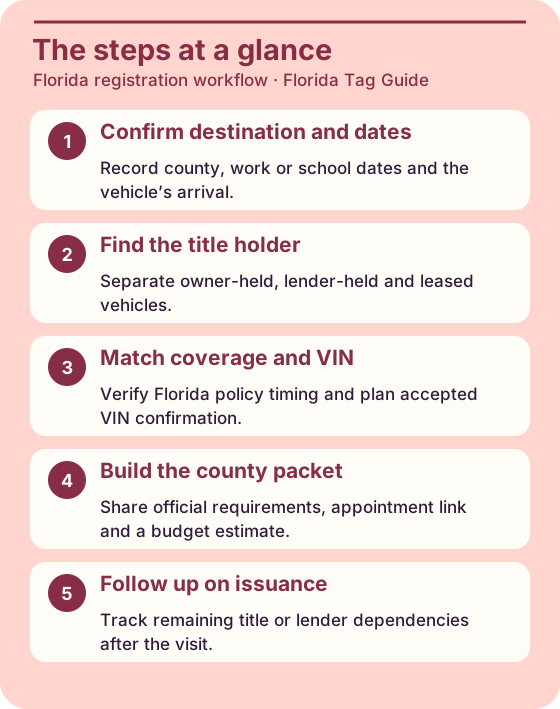
Read the steps as text
- Confirm destination and dates Record county, work or school dates and the vehicle’s arrival.
- Find the title holder Separate owner-held, lender-held and leased vehicles.
- Match coverage and VIN Verify Florida policy timing and plan accepted VIN confirmation.
- Build the county packet Share official requirements, appointment link and a budget estimate.
- Follow up on issuance Track remaining title or lender dependencies after the visit.
Set the insurance task before the registration appointment
Ask the resident to speak with their insurer or a Florida insurance provider about coverage and the proof Florida will accept. The title and registration process generally requires evidence of Florida motor vehicle insurance for the car being registered. Have the resident verify the effective date, correct VIN and policy evidence with the insurer. Schedule the county visit for a time when the required coverage is in force. A quote or transfer request does not prove that the correct policy is active.
Avoid putting insurance and old registration cancellation on the same generic checklist line. People move in stages and may keep one vehicle registered elsewhere while another is already in Florida. The resident should confirm with the agencies and insurer how to maintain valid coverage through the transition and what to do with old plates. A move coordinator can remind the client to preserve the available proof and give the official contact, while the insurer and agencies determine the actual sequence.
Give families with two cars two vehicle rows. One policy change or county appointment might cover more than one, but the coordinator should confirm readiness for each VIN and owner. If a vehicle arrives after the other, the second registration file stays open and can receive its own follow-up and estimate. For Spanish-speaking clients, the Spanish insurance preparation guide gives a concise handoff for that part of the process.
Plan the VIN verification around the car’s location
For an ordinary vehicle previously titled or registered out of state, the Florida office may require physical verification of the VIN. Miami-Dade explains which forms and people are accepted, including when Form HSMV 82042 or the relevant verification section of the title application can be used. The client should verify with their receiving office which route is accepted and arrange access to the actual car. A snapshot of the VIN or a transcription from a transport invoice does not replace a required official physical verification.
Ask where the vehicle will be on the day of the appointment. A household may have shipped the car and planned to go to the county office before it arrives. Move the verification task earlier when feasible or reschedule the relevant part of the transaction. If a title has a VIN error or other mismatch, have the resident ask the county and issuing authority how to resolve it before filing. Do not encourage employees to correct ownership documents themselves.
Some scenarios need a closer look, especially imported vehicles, unusual registration classes or a title with significant restrictions. Miami-Dade points out that certain imported vehicles require FLHSMV inspection before a local office visit. Refer those clients to the appropriate authority with the specifics of their case. For a normal domestic move, the Florida VIN verification guide describes the practical preparation and questions to ask.

Build a budget for each household and show what is conditional
At the quote stage, use the out-of-state car registration estimator to help a resident plan the title, registration, possible plate and tax lines in an ordinary passenger-car case. The estimate can help verify which questions still need answers. Record which Florida county was used, what title route was assumed and whether an eligible prior Florida plate record has been verified. A new plate, renewal, service charge or lien-related decision can change the total.
Discuss documentation of previous tax and time the resident used the car outside Florida. Florida DOR describes a presumption for a vehicle used for at least six months outside Florida in another state, the District of Columbia or a U.S. territory before entering Florida, subject to documentation and the applicable rules. A car just purchased elsewhere can present a different tax question and a documented credit for qualifying tax already paid. Your role is to surface the dates and records that the office will ask about. Allow the proper authority to decide whether an exemption or credit applies.
Here is a common handoff: a resident arrives with a sedan they owned and used for several years and a second car purchased shortly before the move. Estimate them separately and ask the resident to gather proof of the prior use on one and purchase and tax evidence on the other. Avoid copying one household tax assumption to both vehicles. A mobility coordinator can include the six-month use tax guide with the budget worksheet where relevant.
Hand off the official appointment with the correct service
Share the official county or FLHSMV location link and the type of service the resident should verify, such as a motor vehicle title and registration transaction involving an out-of-state title. An office can support vehicle transactions, driver license services, or a particular subset. Follow the published instructions for location coverage, scheduling and acceptable documents. A move-in session held at a nearby real estate office does not determine where a motor vehicle transaction can be processed.
Set a readiness checkpoint before the appointment. Confirm the resident has acceptable identity documents for required signers, original or office-approved ownership evidence, applicable lender or lessor documents, Florida insurance, and proof the physical car or accepted verification is available. If an issue remains, have the resident ask the office for the needed alternative. Send a short appointment summary with the official link, today's known tasks and the open question to ask at the counter.
The resident can keep originals accessible through the move. Suggest that they carry them in a secure place they control rather than put them in the moving truck with household boxes. Handle personal data through the adequate channel for your organization and the authorized agency. A coordinator can track whether proof of insurance was prepared without attaching the card to a general email. The resident can confirm the specifics directly with the insurer and the applicable office.
Turn the appointment into a follow-up that closes the vehicle task
After the appointment, mark what was issued, what is pending, and who will follow up. A registration can be issued in an eligible lienholder or documents-pending situation while the Florida title path is still open. Ask the resident to confirm the status with the office and keep authoritative documents. Do not close the file solely because an appointment occurred or the parent organization reimbursed the original estimate. The next coordinator should be able to see whether the remaining dependency is a lender, the resident, or the office.
For employees whose company helps reimburse relocation costs, distinguish the estimated budget from the receipts needed under their employer’s process. Collect expenses in approved systems with the minimum private information needed. If actual charges differ from an estimate, document the reason that the resident or official office can verify, such as an additional plate or service. The public calculator can support the budget conversation but does not confirm a reimbursable amount.
Turn recurring issues into changes in your arrival guide. When multiple clients forget joint signature requirements, add that question before appointment scheduling. When shipped vehicles arrive after a reserved VIN check, record the transport timing and the options the office accepts. When an employer repeatedly asks what a resident should budget, send the calculator link alongside a short county and title track. It becomes a practical starting point for the next arrival without presenting the private guide as the agency.
- Check county and title path for each vehicle.
- Record whose action is pending and the next date to follow up.
- Separate estimated charges, official receipts and reimbursements.
- Keep VINs and identification in approved channels.
Walk through a two-vehicle move with a lender in the mix
A client is moving to Miami-Dade with two cars. One has a title in the owner’s folder and will arrive with the family. The other is financed and is on a transporter scheduled for the following week. The coordinator shares the county guidance, helps the resident identify the lender’s route and checks whether both vehicles can be taken to the intended appointment. The insurance task goes to the resident and the carrier. The budget uses two estimates with separate lien and document assumptions.
At follow-up, one car may be finished while the second still has a title dependency. The coordinator records where the resident should check the second case and asks them to keep the final registration records. On the next referral the same intake structure is ready. The county, title, policy, verification and timing are checked anew for the new resident rather than inherited from the Miami-Dade example.
Frequently asked questions
Can a relocation company file Florida vehicle registration for a customer?
This workflow covers practical preparation and links to the official office. The resident or an accepted authorized representative should follow the office’s filing and identification rules.
When should a transferee contact a lender or lessor?
As soon as they know the move and title destination. Confirm the county process and document requirements with the office before waiting for a specific appointment date.
Can an appointment happen before the vehicle is shipped to Florida?
Ask the office what accepted VIN evidence is required. The resident may need the physical car or an appropriately completed verification form before the transaction can proceed.
Does every Florida relocation share a 30-day deadline?
Counties give general new-resident guidance. Certain nonresidents have a separate statutory timeline, and registration or insurance expiries may require earlier action. Verify the applicable timing with the official agency.
What should the coordinator send after intake?
A dated summary with the official county link, the client’s title and coverage tasks, a conditional estimate for supported vehicles and the next question to resolve.
Official sources
- Miami-Dade Tax Collector new-resident titling, insurance and verification guidance
- Orange County Tax Collector identification and out-of-state vehicle documents
- Palm Beach County Tax Collector new-resident vehicle and reservation guidance
- Florida Statutes § 320.38 registration rules for certain nonresidents
- FLHSMV notice on out-of-state liens, leases and pending titles
- Florida Department of Revenue motor vehicle tax and prior out-of-state use
- FLHSMV initial registration fee procedure