
What to do if you lost your Florida car title before registration
First check whether the title is electronic or paper, who is listed as the owner and which state issued it. For a missing Florida paper title, an eligible applicant generally uses Form HSMV 82101. An electronic title, a title lost in the mail and a sale with a missing title follow different procedures.
Estimate title and registration costs after fixing the paperwork
Check which document is actually missing
People often call every vehicle document a title when they need to find one quickly. Look at the wording on the last paperwork you received. The certificate of title shows the ownership record. The registration certificate shows that the vehicle is currently or was previously registered. A title application, a dealership purchase agreement and a payment receipt record different parts of a transaction. If the registration card is the only thing you lost, look for a replacement registration through the official channel. Ordering a duplicate title will not replace the record you were trying to find.
If you need to transfer or prove ownership, use Florida’s Motor Vehicle Information Check or ask the county about the current title status. It helps to have the VIN or title number from your existing records. Find out whether Florida issued the title, whether the record shows paper or electronic, and whether it lists a lien. A missing paper in a glove box means little by itself. The record may have been electronic all along or the lienholder may have the original. If the title was issued by another state, ask that state’s motor vehicle agency how to replace it and ask Florida which resulting document it will accept.
| What the record shows | Usual next step | What to verify |
|---|---|---|
| Florida electronic title | Request a printed title if one is needed | Owner eligibility, lien and delivery address |
| Florida paper title lost or damaged | Apply for a duplicate | Who must sign or apply |
| Florida title ordered but never delivered | Ask about lost-in-transit processing | Issue date and the address used |
| Paper title issued by another state | Contact that state for replacement | Whether the lender must act |
| Seller remains titled owner | Have seller resolve title before transfer | Whether the county supports a combined appointment |
Print an electronic title when paper is actually needed
Florida can keep a title electronically. If that is the record type, an eligible owner may be able to request official printing and delivery or visit an office that prints it. Ask whether your ownership, lien or address status affects the option. The FLHSMV duplicate procedure specifically separates an electronic-title record from duplicate and lost-in-transit title requests. Start with the process that matches the actual record, even if a friend told you to submit a duplicate form for every title question.
There are legitimate reasons to request the paper. You may be planning a private sale, completing paperwork requested by a different state or gathering an original for another transaction. Ask the office that needs it whether paper is required and whether it will accept an in-person reassignment if you are selling. A printed copy of an online record lookup is useful for your own notes. Request an official paper certificate through the agency when a certificate is needed. If time is short, confirm the official office’s availability and charges before expecting same-day printing.
Prepare Form HSMV 82101 for a Florida paper title
For a Florida paper title that was lost, stolen or damaged, start with Form HSMV 82101 and the current instructions from your tax collector or authorized service center. Select the transaction that describes your situation and complete the vehicle and owner identifiers. Know which person on the title is applying and which other signatures the office needs. The applicant typically shows appropriate identification and pays the applicable fee. If you have a damaged certificate, ask the office whether it wants you to bring it. For a recent move, read the form’s instructions about documentation for an address different from the one already on file.
Check your paperwork for consistency before copying details across. The vehicle year, make and identification number should match the existing record. Use the actual legal owner names rather than the name of the person paying the bill or the person bringing the form. If the record shows joint owners or a business, ask the county how to document the signatures and authority for your transaction type. Clarify any odometer entry the form requires. An agency may need the appropriate disclosure for a transfer, depending on the vehicle and federal and state rules. Avoid guessing the mileage or copying the number from a document dated months ago.
Check the issue date if the title never arrived
A title approved and issued by Florida that never arrived calls for a different question than a title you received and later misplaced. Find the issue date, confirm what service you paid for and ask whether an envelope came back to the agency. Check the mailing address on the transaction receipt. If you moved or an apartment number was left off, tell the office before it processes another delivery. If the title was electronic and no paper was ordered, there may not be a missing envelope to investigate.
The FLHSMV instructions give a lost-in-transit path after the waiting period has passed. Form HSMV 82101 describes at least 20 days and the procedure TL-05 uses wording that the processed date must exceed 20 days. Verify the eligible date with the office. The state procedure describes a no-fee duplicate for qualifying lost-in-transit cases filed within 180 days of the issue date. After the applicable 180-day period, duplicate title fees apply. Keep the receipt and count from the issue date the agency has on record, so you can explain exactly which title did not arrive. A delivery problem with the registration certificate instead uses the registration process.
Have the titled seller resolve a missing title before you buy
A prospective buyer usually cannot act as the current titled owner merely because a deposit was paid or a bill of sale was signed. If the seller says the title is missing, ask them to confirm the state, title type and lien status. The seller can ask about printing an electronic title, replacing lost paper or arranging the qualifying duplicate-with-transfer process. Vehicle possession and a private receipt alone are not a clean chain of title. Avoid treating those items as proof that you will be able to register the vehicle in your name.
The HSMV 82101 form describes a duplicate-with-transfer option for an appropriate transaction. Its instructions call for both parties to be present with photo identification and generally disallow a power of attorney for that combined option, with a narrow insurance total-loss exception described by FLHSMV. Ask the agency whether your facts qualify before building your sale around a same-day visit. If the seller is not listed, a seller says a prior owner died, or another person claims ownership, those situations can require different evidence. Stop at that decision point and have the official agency or a qualified professional explain the legal route before you hand over money.
Read the steps as text
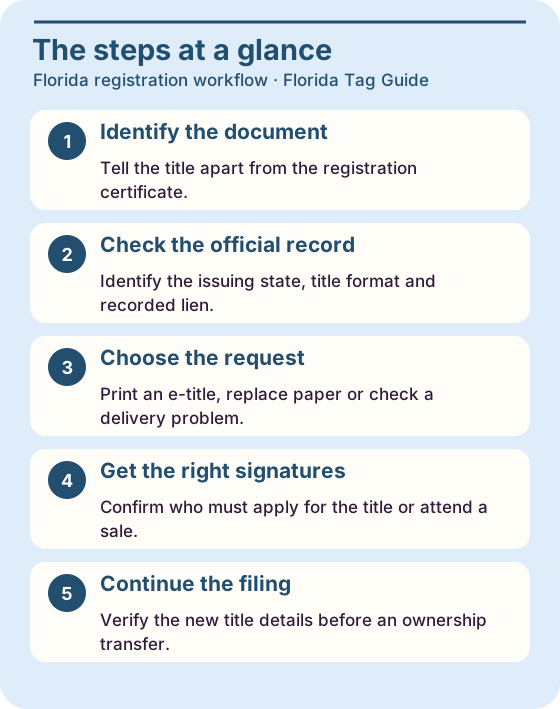
- Identify the document Tell the title apart from the registration certificate.
- Check the official record Identify the issuing state, title format and recorded lien.
- Choose the request Print an e-title, replace paper or check a delivery problem.
- Get the right signatures Confirm who must apply for the title or attend a sale.
- Continue the filing Verify the new title details before an ownership transfer.
Check with the lienholder when the record shows a loan
An active lien changes who has authority to request or receive the title. Read the official status and ask the county before assuming that every owner can request every type of duplicate. Hillsborough County tells applicants that only the lienholder can apply while an outstanding lien is on the title. Where a loan has been paid but a lien still appears, the office may require the lienholder to record a release. The evidence varies with paper and electronic lien handling. Contact the lender through the number on verified loan records and ask if and when it sent the satisfaction.
Do not interpret the last payment date as the date the title record changed. A lender may have received payment but the lien release might still be processing. Ask whether it updated the correct title and VIN and whether the system holds an electronic title after the release. Once the county verifies the status, you can order paper if the next transaction needs it. If you own a financed vehicle already titled elsewhere, see the related guide for how the lender and issuing state can work with a Florida county. Ask about direct delivery rather than treating a lender-held original as lost.
Resolve a title from another state or a different owner
If a Florida applicant lost a paper title issued by another state, the replacement request begins with that issuing agency. Ask whether that state now holds the record electronically, who may order evidence and whether it will issue a certificate for use in Florida. Then ask the Florida county whether it accepts the record you can obtain and whether physical VIN verification is required. Someone moving with their own car has a different starting point from someone buying a car from an out-of-state seller who has no title. In the first case, the existing owner may be able to request evidence. In the second, the seller needs to establish the right to transfer.
If the VIN differs between the title, the vehicle or the registration, ask the agency where the discrepancy originated before using a duplicate application. If a legal name has changed, original title names or signatures may need additional evidence. Duplicate processing is built to reproduce an existing record with appropriate changes under the agency’s rules. It does not resolve a broken ownership chain, a lien claim or a disputed sale. Consult the county about the required ownership evidence in those circumstances. Ask which problem it sees in the record and who must act to correct it so that each call moves the case forward.
Choose a service based on what you actually need to pay
Look for the official county page that distinguishes printing an electronic title from replacing a missing paper title. One is generally a print or delivery service. Another is a duplicate issuance with its own charges and application. Fast title service is a separate option at locations that offer it and when the transaction qualifies. Online and mail methods can have different fees or requirements. Check the total and the delivery time shown by the office for the specific option you plan to use. Eligibility for online service can also differ by situation, especially when a lien or transfer is involved.
If you will title and register the car after resolving the missing document, plan the two costs separately. The independent Florida car sales tax calculator can help estimate tax on a qualifying purchase and the main registration calculator can organize normal plate and registration fees. Those estimates do not decide ownership, produce a duplicate or authorize a transfer. Put the duplicate or fast-title amount confirmed by the county on its own budget line when it applies. This makes it easier to tell an expected printing charge from the larger amount due if you are also buying and registering the vehicle.

Two examples that show why the first check matters
A driver in Pinellas County finished paying off a sedan and thinks the title never came. The vehicle check shows that the lien was released and the title stayed electronic. The driver asks whether the service center can print it for a planned sale. They request the official print transaction rather than declaring a lost paper document they did not receive. Before making a buyer appointment they verify that the print was issued and that the information on it matches the car and owner. If the print was mailed and later goes missing, they would check the new issue date and ask about the transit process.
In another example, a buyer in Orlando meets a private seller who remembers receiving a paper title but cannot find it. The seller shows the registration and confirms that they are the titled owner. The buyer and seller call the county to ask about the duplicate and transfer process and verify both parties can appear. They postpone payment and vehicle pickup until the office can handle the title. They keep separate proof of the sale, title transaction, insurance and registration. The added step protects the buyer from paying for a car they cannot transfer and gives the seller evidence that the ownership update was completed.
Verify the replacement before returning to the registration task
Confirm that the newly issued or located document shows the right owner, VIN and lien status for the transaction it will support. Keep the title in a secure place and carry the registration needed for road use separately. If an old title later turns up after a duplicate was issued, ask the agency how it should be handled and use only the valid current document. If an office refused the replacement request, ask for the specific missing evidence and whether it has to come from the owner, lender or issuing state.
Next choose the registration scenario that actually follows. A purchase involves a buyer’s title application and any applicable tax. A move with the same owner may involve out-of-state evidence and VIN verification. A Florida registration renewal may require none of those ownership changes. Arrange Florida insurance when registration requires it and ask your service center what to bring. If you have only the receipt for a request or proof that a seller started a title application, confirm which remaining steps are needed before driving, collecting plates or treating the transaction as complete.
If you sell after a duplicate is issued, plan the handoff so you can keep a copy of the signed sale documents without giving the buyer conflicting versions of the title. Ask how to submit the seller’s notice and which receipt proves that your particular transaction was recorded. When you need the replacement for an interstate move, confirm the destination agency’s requirements before choosing a service based solely on speed.
Frequently asked questions
Can I register a Florida car with only a bill of sale?
A bill of sale records the deal. Ask the county which valid title or ownership evidence is required for the transfer before relying on it to register the car.
Can a buyer apply for the seller’s missing title?
In a standard private sale, the titled owner should handle it or participate in an eligible duplicate-with-transfer procedure. Ask the agency what is accepted in your case.
What if the car is titled electronically?
Confirm eligibility to have the official electronic title printed or to do the appropriate title transaction at an office. A routine lost-paper duplicate is a different process.
Does Florida replace titles issued by other states?
Ask the issuing state about replacement. The Florida county can tell you what proof it needs to complete your Florida title or registration afterward.
Can I renew registration without finding my title?
Ordinary renewal and replacing a title are separate services. Check your registration status and use the official renewal options if the title is not needed for a separate ownership transaction.
Official sources
- Florida Statutes § 319.29: lost or destroyed title certificates
- FLHSMV Form HSMV 82101 and instructions for a duplicate or lost title
- FLHSMV TL-05: duplicate, returned and lost-in-transit titles
- FLHSMV Motor Vehicle Information Check
- Manatee County Tax Collector: print or replace a Florida title
- Hillsborough County Tax Collector: duplicate titles and liens
- Orange County Tax Collector: title options and posted fees
- Florida Statutes § 319.23: applying for a title and transfer timing