
Can you get a temporary tag after a Florida private sale?
Florida can issue temporary tags for specific private-sale situations, but an ordinary in-state buyer should plan to title and register the car before driving it. Ask the tax collector which temporary-tag purpose fits your transaction and what you must prove before pickup.
Estimate the cost of registering your purchase
Start with the exact reason you need a tag
A Florida private sale often ends with the seller removing their plate and a buyer who still needs to get the car home. The vehicle registration deadline and the legal ability to drive it are two separate questions. A private purchase may fall within purposes listed in Florida Statutes 320.131, but the office issues a tag for a specific purpose after reviewing the case. Before collecting the car, describe why regular registration cannot be completed and ask what type of temporary authorization the office can issue, if any.
For a local buyer with a properly assigned Florida title and a complete application, arranging permanent title and registration is often the straightforward route. Coordinate a tax collector or license plate agency visit while the seller is available, particularly if the title is electronic and you plan to use the joint electronic transaction. When the paperwork cannot be accepted immediately, identify the reason first. A lender release, an inspection that requires the car and an interstate trip are different situations. The office can tell you what proof is needed for each and whether another service would resolve the problem.
- State where you live and where the car will be registered.
- Say whether the title is Florida, out of state, electronic or paper.
- Separate the purpose of the trip from the reason the title process is delayed.
Match your situation to the state’s temporary-tag procedure
The state’s RS-31 procedure gives issuing agents practical categories and time windows. It identifies a 10-day category for certain verification or inspection trips, including a VIN verification needed to apply for a Florida title or registration. It also describes 30-day scenarios, including an eligible sale to a resident of another state who will register there and a narrowly documented delay waiting for the former owner’s Florida title from a lienholder. These durations correspond to the particular approved purpose and should not be carried over to a different case.
A routine Florida private purchase followed by a busy weekend is a scheduling problem. Talk to the office before assuming it can issue a paper tag for convenience. A resident moving in with an existing valid out-of-state title that is subject to a lien may have a separate route when applying to transfer that title. That situation is different from buying a car today from a seller who has an unpaid loan. Give the office details about the party owning the vehicle, who held the title before delivery and what application has already been submitted.
| Situation | What to ask about | First step |
|---|---|---|
| Florida buyer and complete Florida title packet | Permanent title and registration | Arrange a motor vehicle service visit |
| Car needs VIN verification for a Florida application | 10-day verification purpose in RS-31 | Ask whether the vehicle can be inspected where it is stored |
| Previous owner’s Florida title release delayed | Documented lienholder-delay procedure | Ask which lender letter and sale form the agency wants |
| Out-of-state buyer taking an eligible Florida-titled car home | 30-day outbound purpose and applicable tax | Confirm title jurisdiction, residency documents and trip |
Plan an ordinary sale around the permanent registration
Ask the seller to make the ownership document available before you commit to the sale. For an electronic Florida title, see the electronic title guide for a joint transfer option and the official paper alternative. Where a paper title is already available, check that the parties and vehicle identification number match. Complete the required mileage and sale-price entries honestly. Bring your identification, required insurance evidence and any eligible plate information with the title application. Check the county’s appointment policy and payment options early.
If you can arrange the transaction during vehicle service hours, you may be able to complete title and registration before taking possession for the road trip. Ask the seller where the car can stay while paperwork is pending. A valid existing Florida plate can sometimes be officially transferred from a previously owned vehicle if eligible. Use the Florida plate transfer calculator to compare the cost categories, and ask the office to check your actual plate record. The seller keeps their plate in a standard Florida private sale. Once issued, make sure your registration reflects the correct vehicle before you drive.
Ask about the inspection trip if you need a VIN check
A used car being titled in Florida for the first time commonly requires verification of the physical VIN. If the car is waiting at the seller’s location or a storage lot, ask the receiving office whether it will accept a verification completed where the vehicle already sits. An authorized person may be able to complete the form there. Confirm who needs to be present and which form and proof the verifier needs. See the HSMV 82042 walkthrough before you arrange an inspection.
If the car needs to travel for an inspection, ask the county whether its 10-day temporary-tag process applies. Give the branch the title state, the inspection type, the location and the reason you cannot complete permanent registration before the trip. Ask what it needs to see for ownership, insurance, proof of purpose and identification. The office may have separate instructions for a VIN verification and for a rebuilt car inspection. Have a towing or storage alternative ready if the office cannot issue the tag or if the vehicle itself is unsafe to operate. The time limit on an issued tag can affect whether it is useful for your appointment day.
Handle a delay releasing the old Florida title
A lender delay needs documentation. In the example FLHSMV describes in RS-31, the purchaser’s lender provides a signed verification letter explaining that it paid the prior owner’s loan and that release of the Florida title and lien satisfaction is delayed. The procedure also calls for HSMV 82050 so the agency can record the sale when processing the temporary tag. The agent determines whether the evidence is sufficient. Get the county’s requirements for your case before you ask a lender for a letter or schedule a pickup.
If you are buying with cash and the seller still has a loan, ask the lender and title office how to complete the lawful sale and release. A payoff number, an informal promise that the loan will be paid or an unsigned receipt does not establish that the standard temporary-tag procedure applies. You can arrange a hold period at an agreed property while the lender updates the title record. Get agreement from the seller on who will possess the car and how documents will be delivered. A delayed title often has a clearer resolution once both sides know which lender, agency or person is responsible for sending each original document.
- Request the office’s required wording and signer before asking for a lender letter.
- Track the sale record, payoff and lien release as separate steps.
- Agree who will keep the car, keys and paperwork during the wait.
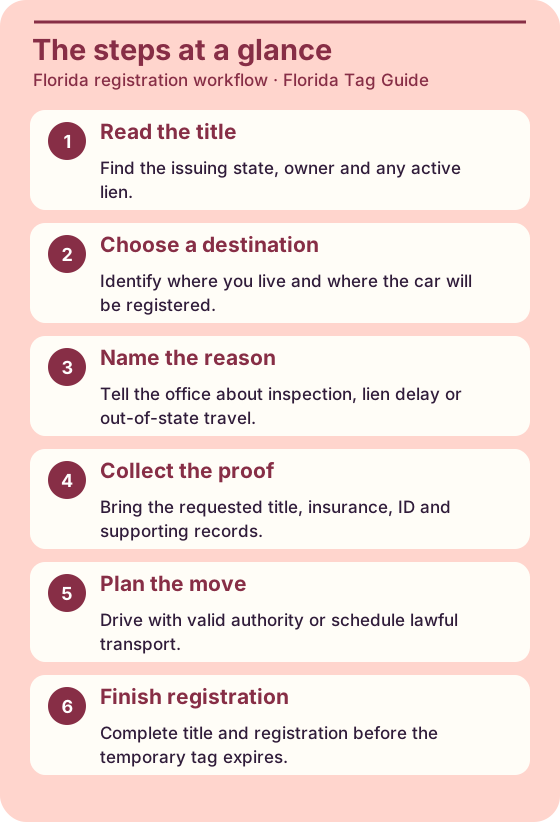
Read the steps as text
- Read the title Find the issuing state, owner and any active lien.
- Choose a destination Identify where you live and where the car will be registered.
- Name the reason Tell the office about inspection, lien delay or out-of-state travel.
- Collect the proof Bring the requested title, insurance, ID and supporting records.
- Plan the move Drive with valid authority or schedule lawful transport.
- Finish registration Complete title and registration before the temporary tag expires.
Check the title jurisdiction for an out-of-state buyer
If you live outside Florida and buy a car in Florida to register at home, tell the office the title state before counting on a Florida temporary plate. FLHSMV procedure RS-31 specifically distinguishes an out-of-state buyer buying from an individual with a Florida title from a buyer in a comparable private sale where the title is from a different state. It describes a potential Florida temporary tag for the first case when applicable tax is paid. For its out-of-state-title scenario, it points the buyer towards another route such as a permit from the home state or transport.
Ask what proves residency and intended registration and whether the office needs a signed out-of-state tax affidavit. Florida DOR guidance describes a partial sales tax exemption for eligible residents of another state buying in Florida, subject to the rules for that transaction. Ask the home-state authority whether it will credit tax paid to Florida. Check the route and validity with the agencies involved before assuming the credential can be used along the entire journey. A Florida resident buying a vehicle outside Florida faces a different situation. Follow the out-of-state purchase guide for how to coordinate the seller, title and legal transport.
Build your packet before requesting a decision
Call the official motor vehicle office for the branch that handles temporary plates. Describe the vehicle, what you received from the seller and why it cannot be permanently registered before you need to move it. Prepare government-issued identification, the title or other accepted ownership evidence, the bill of sale or purchase record and proof of insurance when the agency requires it. Add the purpose-specific evidence the office requests. The precise combination may differ for prior lien delays, verification visits and vehicles that will leave Florida. Counties can list different appointment and service methods.
Here is a concise way to ask. Tell the office you are a Florida resident buying a used vehicle in a private sale. Give the title state, whether the title is available and the activity you need to complete, such as a VIN verification. Ask which office handles the request, which parties must attend, what must be original, what taxes and fees may be due and when the authorization would end. If you already paid the seller and the paperwork is different from what you expected, explain that accurately so you receive instructions for your actual situation.
Ask the issuing branch whether it processes a temporary-tag application during the same type of appointment used to transfer a title. If you are relying on the seller’s attendance or a tow operator’s availability, share the confirmed location and hours with them before making the reservation. After speaking to the branch, add the documents it named to your folder and keep the appointment confirmation with the vehicle pickup plan.
| Evidence | What it resolves | Who supplies it |
|---|---|---|
| Government ID and residence evidence | Applicant identity and the correct route | Buyer or other applicant |
| Title or accepted ownership evidence | VIN, ownership chain and title jurisdiction | Seller or issuing authority |
| Insurance evidence | Coverage for the vehicle when required | Insurer |
| Inspection or lender documentation | Reason for temporary issuance | Office, verifier or lender as appropriate |
Solve a Saturday pickup without an open tag office
Imagine meeting a private seller on Saturday afternoon. The Florida paper title is ready and the seller will remove their plate. The buyer needs to work Monday and hopes a handwritten tag or an older plate can bridge the gap. A safer transaction plan is to choose an earlier closing time when the title office is open, defer vehicle possession and keep the car stored on agreed private property, or arrange lawful transport. Ask the seller and insurer how possession and coverage will work until the car is moved. Give yourself a date by which you will confirm that arrangement before you commit to paying.
On Monday the buyer can take the assigned title and other evidence to the appropriate branch. They verify the selected plate route and complete the title and registration steps. A first Florida title with a used out-of-state car would add inspection and possible travel considerations. Using a storage or carrier plan preserves time to fix documentation without driving under someone else’s plate. If an agency has actually issued a temporary credential, keep the required paperwork, verify its expiration and display the tag as the issuer directs. Plan completion of the permanent registration before the temporary authority expires.

Check tax, permanent charges and expiration separately
Ask about the actual cost of the temporary purpose and which tax must be collected in that transaction. A temporary plate is an operating credential for a limited purpose. It does not pay the permanent registration tax by itself. After issuance, check what the payment receipt covers and retain it with any tax documentation. The Florida vehicle tax and fee calculator estimates the ordinary title and registration bill for a passenger car purchase. Use it to compare a new plate with a transfer when eligible. Ask the agency for the temporary-tag charge and final total for its service.
Use the actual expiry date. A short period after expiry may affect how a violation is classified under the statute, but it does not extend the tag’s validity. If the initial problem remains unresolved, ask the office whether any further authorization is available for that purpose. Keep the vehicle off public roads when no valid authorization covers it. Reconfirm the plan if a weather delay, a missing signature or a lender error pushes your appointment past the end date. Record the date permanent registration becomes effective and check the new plate or transfer record before resuming ordinary use.
Frequently asked questions
Can I drive on the seller’s Florida plate after the sale?
The seller normally removes and retains or surrenders the Florida plate as applicable. Arrange your own valid registration or other authorized transport before taking the car on public roads.
Does a bill of sale let me drive home without a plate?
A bill of sale records the transaction. Legal road operation requires the appropriate vehicle registration or authorized temporary credential, plus applicable insurance.
Can I get a temporary tag for a Florida VIN inspection?
FLHSMV’s procedure includes a 10-day verification or inspection purpose. Ask the issuing office whether it applies and which title, insurance and supporting evidence it needs.
Is every private buyer entitled to a 30-day plate?
No. The issuing office uses the particular purpose and documentation. Florida’s procedure describes specific 30-day circumstances, including an eligible vehicle going to an out-of-state buyer for registration at home.
Can I move my own Florida plate to the car?
Ask the registration office to verify eligibility and complete the official transfer. Have it confirm when your plate is assigned to the purchased car before driving.
Official sources
- Florida Statutes 320.131 on temporary tag eligibility and display
- Florida Statutes 320.02 on required vehicle registration
- FLHSMV RS-31 temporary tag procedures and private-sale examples
- Miami-Dade Tax Collector temporary plate service page
- Manatee County Tax Collector purposes and supporting documents
- Hillsborough County Tax Collector guidance for consumers and dealers
- Orange County Tax Collector private purchase and seller plate checklist
- Florida DOR taxes on vehicles sold to residents of another state