
Buying a car out of state as a Florida resident
Before paying, confirm who can assign the title, how the car can travel, and who will file the Florida paperwork. Keep an itemized tax receipt and arrange VIN verification for a used car receiving its first Florida title.
Estimate taxes and registration fees
Get three commitments before paying
The most useful hour on an interstate car purchase is the one before you pay a deposit. Ask how you will receive the ownership document, who will handle the Florida filing, and what permits or carrier arrangements cover the trip. Get the answers in writing. You can compare the selling price while you wait, but a reduction in price rarely fixes a delayed title or a trip that cannot legally start. If you have booked a flight for pickup, set a time when you need those three questions answered so you can change the plan before incurring more costs.
Start a purchase file with the VIN, seller name, purchase state, proposed delivery date and the Florida county where you live. For a dealer, include the name of the employee handling registration. For a private sale, ask the person selling the car to confirm that their legal name appears on the ownership document and who else needs to sign. Keep a separate list of outstanding items and who is responsible for each. The same document can be the basis of your conversation with the county when a case does not fit its standard instructions.
- Get a written plan for the original title or manufacturer’s certificate.
- Identify the issuer and exact dates of any temporary operating credential.
- Ask whether the seller will submit Florida paperwork or give it to you.
Read the ownership document before you travel
For a used car titled by another state, Florida generally expects that state’s certificate of title, properly assigned to you. Ask what state issued it and what form it takes. A paper title can be reviewed before pickup and delivered when you close. An electronic record may need to be converted or handled through a procedure in the issuing state. A photo can help you catch an error before your trip. The original, an accepted electronic transfer or another form of evidence allowed for that particular transaction is what the Florida office needs to complete its review.
Compare the VIN and names, then work through the assignment boxes. A seller can legally possess the car while a lender still holds the title. Someone might also be selling on behalf of an estate or a co-owner. Ask the person to explain what authorizes their signature and get the county’s requirements for that fact pattern before sending funds. A chain of dealer reassignments is different from an individual offering a title already signed over to somebody else. If there are multiple assignments, ask who will supply the complete chain and where the final assignment to you will appear.
Give the dealer or private seller a clear handoff
An out-of-state dealer may have a service that files Florida paperwork. Ask for the name of the title processor, which state and county will receive the application, and what proof you will receive when it is submitted. The invoice should identify tax actually collected and show payments separately from the price of the car. A line labeled tags can describe a deposit or an estimate. Ask what happens if the final government amount differs and have the dealer explain the timing of any balance or refund. Keep the written answer with the invoice.
In a private purchase, plan to handle the Florida application yourself unless you have specifically arranged an authorized service. Have the seller complete the assignment according to the issuing state’s requirements. Ask about any local notarization requirements that apply to the seller’s transaction and confirm what supporting evidence Florida will want to see. Put the agreed price, date and VIN on a complete receipt or bill of sale for your records. When possible, plan the closing around a time when you can contact both the selling state and Florida offices if the paperwork exposes a question.
| Seller | Ask before closing | Keep afterward |
|---|---|---|
| Dealer handling Florida filing | When is it sent and what taxes are collected? | Signed buyer’s order and filing confirmation |
| Dealer handing you a packet | Are all reassignments and originals included? | Full title packet and buyer’s order |
| Private seller | Can all owners complete the assignment now? | Assigned original title and signed sale record |

Decide how the car can leave the pickup location
The travel question belongs to the agency that issues the operating credential and to the rules that apply along your route. A selling dealer may be able to issue a temporary credential, and a private sale may require a different permit or a carrier. Ask where the credential is valid, whether it covers the full journey, which proof must travel with the car, and what you should do if the document will expire before pickup. Check the rules of the purchase state using its official motor vehicle agency. Confirm coverage with your insurer for the pickup date and every person who will operate the vehicle.
If you already own a Florida plate, ask the Florida office when an official transfer can take effect. You may want to compare the cost of a new plate with a Florida plate transfer. Physical possession of the old plate cannot establish that the new car is registered under it. A signed purchase agreement and an active insurance policy also serve different purposes from registration. If the permit cannot be obtained before collection, use a properly arranged vehicle carrier, postpone pickup or coordinate a lawful tow for a shorter trip. Get a plan before ending the seller’s coverage or booking a driver.
- Record the issuing agency and expiry date.
- Carry the documents required with the credential.
- Allow time to change the travel plan if title delivery slips.
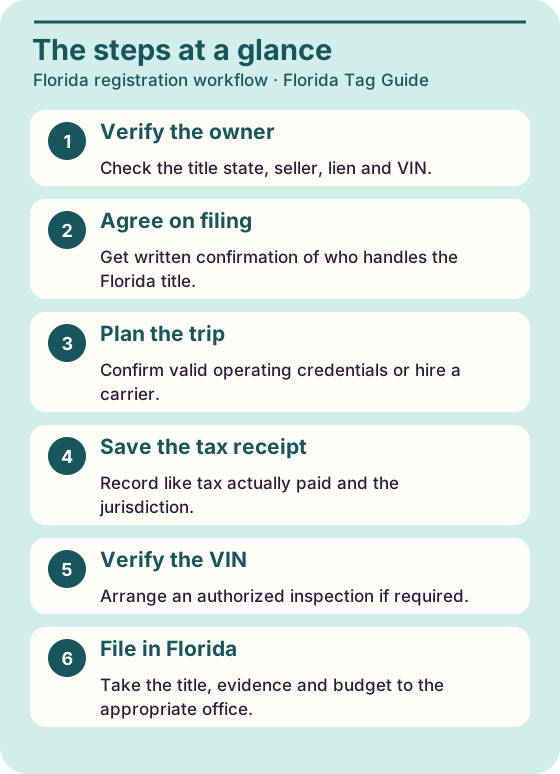
Read the steps as text
- Verify the owner Check the title state, seller, lien and VIN.
- Agree on filing Get written confirmation of who handles the Florida title.
- Plan the trip Confirm valid operating credentials or hire a carrier.
- Save the tax receipt Record like tax actually paid and the jurisdiction.
- Verify the VIN Arrange an authorized inspection if required.
- File in Florida Take the title, evidence and budget to the appropriate office.
Budget Florida use tax and keep the original receipt
Florida generally applies its 6% use tax and any applicable county surtax when a vehicle bought elsewhere is brought to Florida to be titled or registered. The Florida Department of Revenue explains that a like tax lawfully imposed and paid in another U.S. jurisdiction may be credited toward Florida use tax and surtax. Separately identify the taxing jurisdiction, the taxable amount and the amount that was actually paid. A receipt that shows an all-in price with a dealer fee, a temporary tag and state tax combined can make that credit difficult to establish.
A simplified example shows why the receipt matters. Assume a $20,000 taxable purchase, no trade-in and a Florida county surtax of 1% on the first $5,000 of the taxable base. The statewide amount is $1,200 and the county amount is $50 before credits. If the Florida office accepts an $800 credit for like tax already paid, the difference in this illustration is $450. Title, plate, registration and any office charges still have to be considered. Enter your actual figures into the Florida vehicle tax calculator and check which year’s county rate applies.
Arrange Florida insurance and VIN verification
Get Florida insurance evidence suitable for the vehicle registration application. Have the insurer confirm the VIN, the insured parties, the start date and what document to show the office. If you are switching vehicles, coordinate removal of the old vehicle with the status of its plate and registration. You can keep a copy of the proposed policy but still need proof of active coverage when the registration is processed. Determine whether the provider needs advance notice if the handoff will happen on a weekend.
A used car being titled in Florida for the first time generally needs a physical VIN verification. Ask whether the branch can inspect the car in its lot or whether it wants a completed form from an authorized verifier. Decide how the car will be accessible without relying on an assumed registration exception. Florida’s VIN verification guide explains what the owner and verifier each check. For a new car, confirm whether the dealer’s manufacturer’s certificate of origin and applicable new-vehicle exception fit the case, especially if a listing calls it new but documentation shows it was already titled.
| What you need | Compare against | Who can resolve a problem |
|---|---|---|
| Insurance evidence | VIN and effective date | Insurer |
| Physical VIN verification | VIN on vehicle and title | Authorized verifier or Florida office |
| Manufacturer’s certificate if relevant | Exact vehicle and assignment | Selling dealer |
Build the Florida title and registration packet
Start with HSMV 82040 MV, the motor vehicle title application, and the instructions from your chosen county. Separate originals from reference copies. Put your identification, assigned ownership document and application at the front. Behind them place the insurance evidence, any VIN verification, the bill of sale, invoice and itemized tax receipt. If you financed the purchase, include the lender’s information and the document trail the dealer or county requested. A printed list of documents can make it easier to follow the clerk’s request without handing over papers unrelated to the case.
Choose an office that handles out-of-state titles and confirm appointment and payment instructions. Check service eligibility before driving to a branch that only offers driver licenses or renewals. Call out special issues in advance, such as a vehicle that is arriving with the title already assigned to a different person or an out-of-state electronic lien with no paper document available. Give the office a short statement of the situation and note the exact missing item it identifies. In a routine Florida purchase title transfer, Florida Statutes 319.23 sets a 30-day filing period from delivery of the vehicle. Calculate your schedule from delivery and address delays early.
- Record the date, agency and any case or receipt number.
- Bring proof of any eligible existing Florida plate.
- Ask which documents the office retains and what proof you leave with.

Walk through a used car pickup in Georgia
Imagine an Orlando resident buying a used car from a Georgia dealer that does not file Florida registrations. Before the trip, the buyer asks for the title state, confirmed delivery date and an itemized buyer’s order. The dealer explains how it lawfully handles temporary operation for that sale and identifies when it will deliver the assigned title. The buyer checks whether the written travel arrangement covers the trip in each state and confirms insurance. They book a carrier instead if the travel credential or sale documents will be unavailable at collection.
The buyer selects Orange County for the estimate, enters the taxable purchase amount and records any amount actually paid as like tax in Georgia. They compare two otherwise identical runs if the Florida plate situation is unclear. The difference helps them prepare for the appointment without deciding whether the county will accept the old plate. Next they check the original title against the VIN and the buyer’s order, arrange VIN verification and book the appropriate county service. If the dealer has to send the title later, the buyer asks which day it is expected and contacts the county about the timeline before the filing deadline is close.
The sequence is equally useful when buying remotely. Ask a carrier when it can accept the vehicle and ask the seller when the ownership packet can be sent. Schedule your Florida appointment around the later of those two dates so the VIN can be verified and you have the documents in hand.
Fix a missing title, delayed lien or conflicting invoice
If the office pauses the application, note the exact document it needs and whether the issuing state, dealer or lender must correct it. An incorrect mileage entry on a prior state title may need correction in the issuing state. If the title is still in a lender’s name or possession, get instructions for the lien satisfaction or title request rather than trying to work around the documentation. Do not write over any assignment or mileage fields. Ask for the proper correction procedure so the next document you bring can be accepted.
If the title is ready but the tax receipt is inadequate, ask the seller’s accounting department for a transaction record that separates state and local tax from other charges. Check whether the current invoice is a draft or a final posting. If an estimated payment is still in dispute, take the evidence you have to the office and ask what it can credit. Keep the travel status separate during the delay. A car that remains in storage or travels by carrier can wait for documentation without creating a deadline tied to a temporary operating credential.
Frequently asked questions
What if the seller only has an electronic title?
Start with the issuing state. Ask the seller for the transfer mechanism or how to obtain the ownership document Florida will accept. Contact your Florida county while you can still make the purchase conditional on receipt of that document.
Do I get credit for all the charges paid in the purchase state?
Florida’s credit concerns a qualifying like tax lawfully imposed and paid. Set aside registration charges and dealer fees when collecting proof. The county reviews your tax receipt before applying the credit.
Do I need a VIN verification if the car has an out-of-state title?
Generally yes if it is a used vehicle being titled in Florida for the first time. Ask whether the office can inspect it or accepts verification completed beforehand.
Can the seller’s tag stay on the car for the trip?
Determine separately what operating credential the issuing agency will authorize for your transaction and trip. Arrange transport if you cannot obtain an authorized one before collection.
What if I already owned the car before moving?
Use the new-resident calculator flow. Bring records of prior out-of-state use and any tax you paid, and check whether the title is in your possession or held by a lender.
Official sources
- Orange County Tax Collector directions for vehicles bought outside Florida
- FLHSMV original title procedure and accepted ownership evidence
- Florida Department of Revenue guidance on out-of-state vehicle tax and credits
- FLHSMV VIN and odometer verification form HSMV 82042
- Florida Statutes 319.23 on applying for a motor vehicle title
- FLHSMV temporary tag procedure RS-31
- FLHSMV official office directory