
Florida vehicle registration checklist for small businesses
First confirm the legal owner, permitted signer, insurance and official vehicle class. Use an ordinary passenger-car estimate only when that class and transaction fit, then confirm the company’s documents and fees with its county or authorized provider.
Budget for an eligible passenger car
Decide which vehicles belong in this process
An ordinary company-owned sedan can need a title and an ordinary registration. The company still needs to show who owns it, who is authorized to sign and what insurance covers the VIN. Start with a scope check for each vehicle. A route manager’s passenger car, a service truck with a special classification and a vehicle that crosses state lines in a commercial operation can lead to different registration workflows, even if all three appear in the same internal fleet list.
Record the manufacturer’s vehicle details, intended use, expected operating area, owner, lease status and the official registration class if known. Ask the county or appropriate commercial vehicle office to determine a classification when there is doubt. A company can buy a small pickup that the relevant agency classifies differently from its standard passenger vehicle. The public calculator estimates ordinary passenger-car transactions. Use it where the operation and class fit those assumptions, and send other cases to the specialized or county channel.
A small fleet manager can use the same intake worksheet for new purchases and replacements without assuming the state’s permanent fleet program applies. The permanent fleet registration statute gives minimum counts of 100 motor vehicles or 25 trailers or semitrailers for its defined nonapportioned program, among its other requirements. Three sales cars still need their own documentation and renewal records. This guide helps a local small business manage that recurring work vehicle by vehicle.
Put the intended legal owner on the purchase documents
Decide with the people authorized to buy the vehicle whether it will be titled to the company, an individual or a lessor. A company paying the bill is not enough to determine the title owner. Match the buyer in the proposed invoice or buyer’s order to the legal name to be used in the title application before the vehicle is released. Confirm that the insurance and any financing use the intended ownership arrangement. Record lease and lender information if it matters to the application.
For example, a small design firm may buy a sedan under a brand name it uses in public. The company’s actual registered legal name can be different. The office manager should resolve the discrepancy before a signature or vehicle policy is issued. Do not copy the logo name into the title field and hope the fictional name is accepted as the owner. Ask the dealer or tax collector what entity and business-name evidence they need for this transaction.
When a founder wants to move an already-owned personal car into the company, treat that as a potential ownership change with its own title, tax, lien and insurance questions. Do not apply a simple new-purchase estimate to the transfer without checking the facts. Even if the same person uses the car daily, the previous individual owner and the proposed business owner are distinct records. Determine what documentation and tax treatment the appropriate agency requires before choosing a price or a route.
Prepare business identification and proof of signer authority
Florida Statutes §§ 319.23 and 320.02 address identification for business applicants and the registration address used in the application. For a repeatable intake, have a current entity record and the applicable federal employer identification number or other acceptable business evidence available through an authorized process. Lee County explains that its office looks for proof of authority to act on behalf of the company and often accepts a Division of Corporations printout identifying authorized people for that purpose. Check the actual office instructions for the transaction and the responsible entity.
If the employee who will visit the office is not identified as authorized in the company’s records, ask the receiving office what additional authority it accepts. Examples in local procedures can include an appropriate authorization letter or an accepted power of attorney, depending on the transaction. Confirm the form, who must sign, acceptable identification and whether an original is required. An internal approval email can document a purchase inside the business while still failing to establish the employee’s authority at the counter.
Maintain a current list of approved signers and review it when managers leave or a company name changes. Keep an authorized copy of the specific proof required for the visit. A general vehicle register shared across maintenance and dispatch can hold the due date and assigned staff member. Identity documents, entity credentials and financing paperwork belong in the company’s access-controlled record set for the people who actually need them.

Coordinate the vehicle policy before the registration appointment
Contact the company’s insurer before scheduling an appointment around a new vehicle. Explain the ownership, how the vehicle is used, where it is garaged and the drivers or operations the carrier needs to know about. Ask the carrier for proof accepted for the Florida transaction and check that the policy is effective and identifies the correct vehicle. Coverage for an old sales car should be verified before someone assumes it carries to a new one.
Give your insurer and official processing channel the necessary detail through their proper methods. An estimate of government fees does not need the insurance card or full vehicle paperwork. A company can still plan a purchase from the county, type of ordinary vehicle, confirmed plate scenario and expected price without placing documents in a general operations channel. Document that the policy evidence was checked and where the approved processing staff can see it.
If the company is buying a replacement, ask how the outgoing car stays covered and registered while it is still driven. Record the event or date that triggers a plate change and who will verify it with the agency and insurer. Returning keys, transferring ownership, removing the plate and changing insurance can be separate events. Assign them to the person responsible for each event instead of leaving dispatch to deduce the plan from a note about billing.
Choose the right filing path for the acquisition
For a normal retail purchase at a licensed Florida dealership, give the dealer the intended company ownership and signer details early and verify the dealer’s responsibility for the filing. Ask how you will receive the registration, how any lien is recorded and which fees are included in the written price. For a private purchase, identify who must apply for the title and which ownership evidence is required before paying. Put delivery and official completion in the task list for accounting and operations.
An out-of-state acquisition needs a different intake. Identify the title jurisdiction, the status of the ownership document and who has it. Request the official guidance for the required VIN verification and tax treatment, including any documentation of tax paid to another jurisdiction. Arrange any authorized physical verification early if the vehicle is not going to be parked near the office. If the vehicle is being shipped or is not ready to drive, make a separate lawful plan to get it to a required inspection or appointment.
At a private sale, arrange for the signed valid ownership paperwork and an agreed handoff before the old owner removes their plate and leaves. Plan how the company will transport or register the vehicle without assuming it can leave on the seller’s plate. For a dealer purchase, ask for a confirmed departure arrangement rather than pricing only the title. A completed sale and a lawful on-road registration are distinct milestones in the vehicle acquisition record.
| Transaction | First practical check |
|---|---|
| Florida dealer acquisition | Correct company name and approved signatory in the deal packet |
| Private sale | Transferable ownership evidence and legal transport or registration plan |
| Out-of-state acquisition | Title jurisdiction, VIN verification and tax documentation |
| Personal car moved to entity | Ownership, lien and tax treatment before a title change |
| Leased vehicle | Lessor’s procedure and evidence of authority |
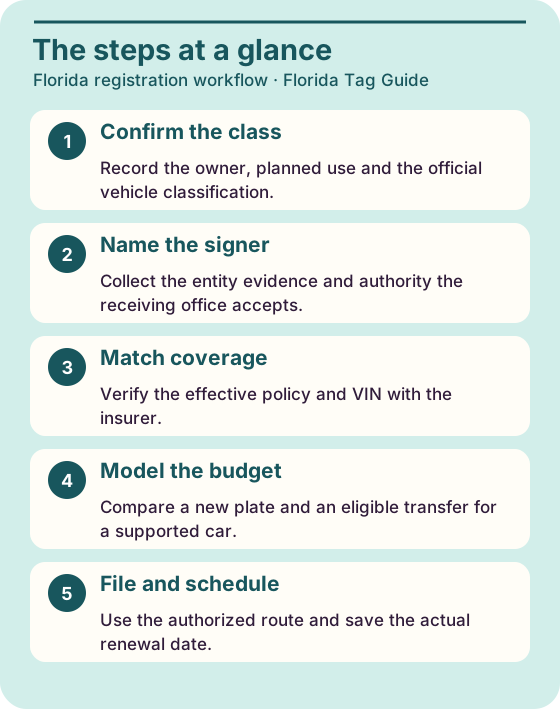
Read the steps as text
- Confirm the class Record the owner, planned use and the official vehicle classification.
- Name the signer Collect the entity evidence and authority the receiving office accepts.
- Match coverage Verify the effective policy and VIN with the insurer.
- Model the budget Compare a new plate and an eligible transfer for a supported car.
- File and schedule Use the authorized route and save the actual renewal date.
Build a budget for one eligible passenger vehicle at a time
For an ordinary passenger-car acquisition, run a scenario with the actual Florida county, confirmed vehicle information and purchase type. In the first budget draft, choose a new plate if you have no verified transfer information. Add a second estimate for an eligible prior Florida record only when you can identify the record for review. The $225 initial registration fee generally applies when an eligible plate or prior record is unavailable and no exemption applies. Other state and local line items depend on the class and facts. Check eligibility before treating any savings as established.
Suppose an agency is replacing a passenger sedan previously titled and registered to the same legal entity. It can compare a transfer scenario with a new plate, then ask its approved processor to confirm that the old registration and new vehicle qualify. If the salesperson says the company is also taking a service van, start a separate class check for that vehicle. Do not simply copy the sedan’s fee estimate or assumed transfer status into the second purchase.
The estimator can help clarify which registration questions remain at the budget stage and lead the user to the appropriate county service. Use your controller, the dealer’s itemized quote and the official fee determination for the final amount. Track the difference between the estimate and official charges, especially when an optional expedited service or a changing vehicle specification moves the total. For someone reviewing a dealer quote, the out-the-door price checklist shows why taxes, public charges and private services deserve separate lines.

Escalate commercial classification before setting a purchase budget
If the vehicle hauls freight, operates outside Florida in a commercial operation, is a heavy truck or part of a combination, ask the proper commercial office to confirm the rules. Commercial classification can depend on factors such as gross weight, axle count, combination, use and operating jurisdictions. Interstate apportioned registration, fuel tax requirements and other motor carrier obligations have separate eligibility criteria. A quick consumer estimate for a passenger car cannot price or verify any of those programs.
Ask for the manufacturer’s vehicle details and the actual operating plan, including planned trailers or other units. Send the question to the commercial vehicle office and request the correct process for the class in question. Keep the name of the program and the official link in the internal intake so a coworker can pick it up. When the commercial route is confirmed, prepare a separate commercial budget based on that procedure and the approved processor’s instructions.
Even for vehicles operated only within Florida, confirm the applicable classification when a vehicle’s weight, markings, type or intended use place it outside the ordinary passenger-car process. Using the word “fleet” to describe several vehicles does not decide which registration statute applies. Use the same monthly internal inventory for all vehicles, but keep the filing authority, paperwork and used estimate method attached to the appropriate class for each one.
Keep renewals, replacements and proof in one operating record
After the transaction, record the VIN, assigned unit, official registration class, responsible owner and expiry from the issued registration. Record the insurer and the date someone needs to revisit policy evidence. Verify which person will receive notices and that company and garage addresses are correctly documented where required. During a periodic review, look for upcoming expiries, replacement vehicles and stale records so you can schedule visits or renewals before a driver is affected.
Use the office or authorized online option for a renewal that qualifies. A company vehicle’s due date can differ from an employee’s personal vehicle, so use the registration evidence in hand instead of assuming a familiar birthday month or office convention. If you have units with several renewal dates, assign a person to check each due date against source copies. A manager can run that review while the dispatcher checks which vehicle will be available for any appointment.
For a replacement cycle, match the outgoing and incoming VIN, the expected plate decision and the final registration document. Ask the county when a policy change or plate surrender is relevant. Revisit the calculator when bidding on an eligible replacement car, when estimating annual purchasing budgets or when comparing different initial or transfer assumptions. Use the official renewal notice or agency results for amounts due on an already registered vehicle.
Apply the process to a two-car purchase
A property services company decides to buy two sedans for field coordinators. One replaces a registered unit and the second is an additional car. The buyer confirms the LLC’s legal name and signer for both. The insurer provides evidence for the incoming vehicles. The title desk verifies the old record and decides whether that plate can move. The purchase lead then keeps the replacement estimate and the additional car’s new-plate estimate side by side. Once approval is available, the company hands the dealer the confirmed ownership and coverage records through the dealer’s process.
When the dealer confirms filing, the office manager records two different renewals, verifies that each registration matches the correct unit and places the delivery evidence where the relevant driver can find it. If the business chooses a pickup for the next purchase, the class check takes place again. The record gives repeat buyers a useful template while leaving vehicle type, registration path and costs open to verification for every acquisition.
Frequently asked questions
Does a small Florida business need a permanent fleet plate?
Florida’s permanent fleet registration statute has specified eligibility thresholds and other conditions. A business with a few ordinary passenger vehicles generally works through the applicable vehicle-by-vehicle registration process.
Can an employee sign for a company vehicle?
Verify that the employee has authority under the company’s documents and that the receiving office accepts the evidence presented for that transaction.
Can I transfer the owner’s personal plate to a company car?
The registration and title ownership matter. Have the authorized processor verify eligibility when the registered owner and the proposed legal owner are different.
Does a passenger-car estimate cover a heavy work truck?
The tool is designed for ordinary passenger-car estimates. Ask the county or commercial vehicle office to confirm any truck, heavy or specialized classification and fee schedule.
How should a business estimate an annual renewal?
Use the actual registration and official renewal channel for an existing unit. Use the calculator when planning a supported new purchase or passenger-car replacement.
Official sources
- Florida Statutes § 320.02 on registration applications and business identification
- Florida Statutes § 319.23 on applying for a certificate of title
- Florida Statutes § 320.0657 on permanent fleet registration
- Lee County Tax Collector identification and signer guidance
- FLHSMV signature and identification requirements for title and registration
- Florida Department of Transportation commercial vehicle and IRP FAQ
- FLHSMV initial registration fee procedures