
Florida dealer title and registration checklist for title clerks
Track the delivery date, buyer and vehicle records, ownership chain, applicable insurance and tag path from intake to final filing. Use the approved dealer channel and record title submission separately from any temporary tag or transfer.
Preview the buyer’s registration estimate
Create the title record at delivery
Open the title clerk’s work item when the car is delivered, with the vehicle record, buyer record, sale record and any temporary registration paperwork connected to the same deal. Florida section 319.23 generally requires the dealer to obtain a certificate in the name of a retail purchaser after the purchaser signs the application. For an ordinary motor vehicle transfer, the statute specifies filing within 30 days after delivery. Confirm the rule for an unusual transaction with the agency or your compliance lead. Track delivery as an actual event, so an earlier deposit date or a later appointment does not accidentally drive the deadline.
Use a documented intake with an assigned clerk and a queue for files waiting on a document. The intake should still exist when the seller’s paperwork is incomplete. Keep the missing document visible on the record with a contact role, the last follow-up date and the next date the matter will be reviewed. If the dealer continues shopping for proof of ownership after delivery, an ordinary handoff folder can make the issue invisible for several days. A separate exception state allows the clerk and supervisor to prioritize it.
This process is for the typical licensed Florida used-car dealership delivering a vehicle to a purchaser seeking Florida title and registration. Review out-of-state sales, special ownership changes, dealer-to-dealer transfers and commercial registrations separately. A phone quote can start with one scenario. The signed and verified deal packet ultimately controls the filing.
Reconcile the purchaser, address and authority to sign
Review the legal names and ownership that will appear on the title application before the customer leaves. Match the names on approved identification to the specific person or entity receiving title. Verify the registration address that belongs in the application and check whether it also determines the correct surtax county. Examine the difference between a billing contact and an owner. A sales record can legitimately include both while the title application only lists the relevant owners.
Set a clear procedure for co-buyers and business buyers. A co-owner may have to sign or provide accepted authority for another person to act. A buyer representing an LLC might be purchasing in the company’s legal name. That introduces entity identification and signer authority the title desk should verify using the transaction channel’s requirements. Get the right person to sign the correct document. Avoid directing someone to copy a signature because the other buyer already left.
Build an exception for any conflict between the signed sales documents and the intended title owner. A correction at this stage can require reissuing a document and checking the corresponding insurance. Correcting a completed transfer can require a different procedure. Keep copies in the dealer’s approved records and use role-based access through the dealership system for identity documents. The customer should receive only the documents intended for them and instructions tied to their specific case.
Check the title chain from prior owner to buyer
Start with the vehicle’s ownership record and the required assignments. Match the VIN and identifying details to the vehicle. Review whether the document is a Florida paper title, an electronic title that needs a permissible transfer process, an out-of-state title, or another ownership record allowed for the transaction. Record who can deliver any outstanding item. A sales invoice and an inventory screenshot can explain where the dealer bought the vehicle, but the filing channel needs the evidence that supports the ownership change.
Check liens, signatures, assignments and odometer disclosures against the current procedure. An out-of-state document can have unfamiliar assignment fields. Refer an uncertain chain or correction to the tax collector or authorized provider instead of writing over an assignment. A customer waiting to take delivery should receive a realistic update on the status of the ownership record. Dealer staff must follow the correct process for a missing title, including applying for a duplicate where appropriate. Starting that request early gives the team time to confirm who can act.
If you intake vehicles at auction, assign the ownership document review during acquisition as well as sale. Compare the inventory’s VIN to the title when it arrives and route any break in assignment to the acquisition desk. Attach the point of contact and a dated request. A title clerk should be able to tell from the queue whether a release has been requested, received, or confirmed in the applicable system.
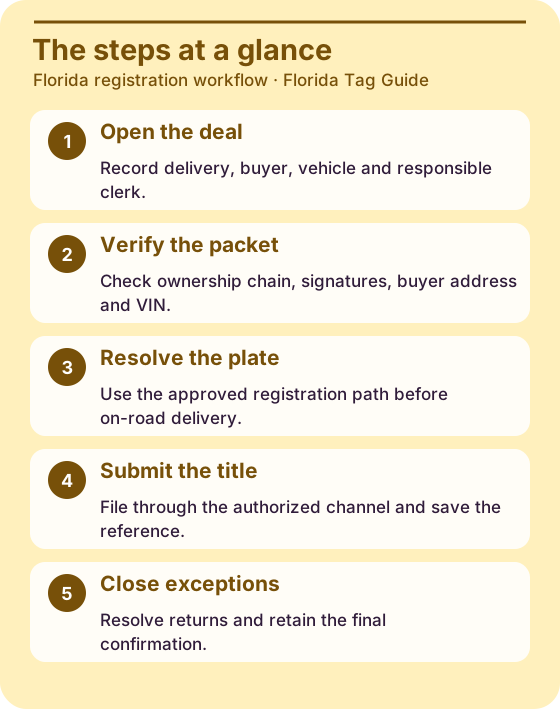
Read the steps as text
- Open the deal Record delivery, buyer, vehicle and responsible clerk.
- Verify the packet Check ownership chain, signatures, buyer address and VIN.
- Resolve the plate Use the approved registration path before on-road delivery.
- Submit the title File through the authorized channel and save the reference.
- Close exceptions Resolve returns and retain the final confirmation.
Assemble the Florida filing packet
Use the current application and instructions for the vehicle and type of work, including applicable form HSMV 82040 MV for an ordinary motor vehicle title application. Assemble the signed application, acceptable ownership evidence, completed assignments and supporting identification. Include odometer information, insurance for the registration and sale or tax evidence as applicable. Attach lender information for a new lien and any accepted documentation for an existing lien that must be recorded or satisfied. Use current official forms from the county or FLHSMV.
Cross-check the VIN at three points: the unit being delivered, the ownership evidence and the insurance or registration evidence. A copied character from a stock list can send the desk from a small correction into a full rejection. Treat vehicle descriptions and buyer names as authoritative only when traced to the source records. If a form needs a motor vehicle identification number verification for a previously out-of-state vehicle, confirm the applicable procedure and the person authorized to complete it.
For a registered lienholder, route the information to your approved electronic lien process. An unfamiliar lender name or a nonparticipating lender should go to a verified exception path instead of selecting the closest matching record. The state’s Electronic Lien and Title procedure explains what dealer EFS users can enter. The same disciplined comparison helps catch a financed deal delivered under the wrong purchaser name or a cash sale mistakenly marked as having a lien.
| Packet item | Review before submission |
|---|---|
| Proof of ownership | VIN, assignment chain, lien status and title format |
| Signed application | Buyer ownership, registration address and authority |
| Registration evidence | Vehicle-specific insurance and approved new or transferred tag path |
| Tax and sale record | Sale date, price, applicable county and separately tracked charges |
| Provider record | Submission, correction or confirmation reference in the approved system |
Know when to use EFS and when to use ETR
Electronic Filing System, or EFS, supports title and registration transactions through authorized participants and approved providers. Electronic Temporary Registration, or ETR, has a different role for reported temporary tags and qualifying temporary transfers. A printed ETR registration document can support a departure under the approved procedure. The title clerk still needs a completed filing record for the permanent transaction. Keep a separate field for each system rather than using a general “tag done” checkbox.
The channel you use depends on your dealer authorization and the transaction. County dealer instructions can show prerequisites for appointments, registration and temporary tag inventory, and give links to the current forms. Have a written list of transactions your provider supports, and a route to the tax collector or authorized agency when the provider cannot process the case. Staff should know who contacts the provider and where to record the answer.
In a system outage, contact your provider or county through the documented procedure. Hillsborough County describes the role of approved preprinted temporary plates for eligible dealerships during certain ETR outages. Confirm permission, inventory and reporting requirements before using them. A system error in a planned plate transfer does not authorize mounting the customer’s plate. For the steps to check that match, use the dealer plate transfer workflow.

Handle the cases that break a routine title packet
A missing owner signature, a lien still visible on record and a rejected transfer are three different problems. A useful exception note carries the issue in plain language, the expected evidence, the next contact and the deadline. Record the date on which a request or rejection occurred. A clerk covering the desk after a day off should be able to take the next action without reopening the deal’s entire paper trail.
A buyer who lives outside Florida and will title the vehicle elsewhere needs a separate review. Section 319.23 specifies a different dealer duty for a purchaser residing in another state or country, including reassignment or transfer and the purchaser’s approved affidavit. Verify the destination jurisdiction and the applicable Florida tax and temporary tag procedure through the dealer channel. Reusing the standard Florida-resident packet can leave both the required affidavit and the buyer’s home-state next steps unclear.
When a buyer’s plate cannot be transferred, speak to the customer before changing the quote to a new plate scenario. For a customer expecting to drive away, resolve how the car can depart under the valid registration path with the desk handling issuance. If the vehicle’s title differs from what was represented to the customer, the title issue and the communications around it need escalation rather than a temporary workaround.
Give the sales desk a preflight that produces better packets
Ask the salesperson to provide the registration county, basic vehicle information and expected plate path at the first formal quote. They can open the Florida vehicle registration calculator and compare the estimated title and tag lines for an eligible transfer against a new plate. The estimate can also give the buyer a checklist of things to discuss or bring. Staff can share the tool as a public estimate without asking the buyer to upload personal documents to it.
The sales worksheet should indicate which parts came from an estimate and which were confirmed in the dealer system. For example, state “customer reports an available Florida plate, verify owner and record” rather than writing “plate transferred.” If a customer expected to keep a second car on the road, talk through that plan before committing to a plate scenario. When local and final charges differ, trace the difference to the authoritative transaction and update the signed sale documents according to your process.
An estimate also helps during repeat training. Have a new sales employee compare a simple transfer with a customer obtaining a first Florida plate. Have them explain how an estimated initial fee depends on eligibility, what evidence allows the title desk to check, and how to say the amount could change. Combine it with the out-the-door quote checklist so sales and title use the same definitions.
Measure filing progress and resolve rejections promptly
Track official submission, return for correction and final completion as separate events. In a daily review, sort routine deals and blocked deals by delivery date. Record the reference number and the actual response from the filing channel. Escalate a file early when a missing lien release or ownership document threatens the filing deadline. A temporary plate expiry is a useful customer-service reminder, but it does not change the filing deadline in the underlying statute.
Set a customer update cadence that reflects the case. A good update says which step is complete, what evidence is still needed and when you will review the file again. If a temporary tag is close to expiring, verify with the approved channel what the buyer can do next. Avoid promising an automatic extension or a second tag on every deal. Use the same care when telling the buyer a title document should arrive in the mail. Confirm the address, title delivery choice and where the record actually stands.
Section 320.27 provides a five-year recordkeeping period for the dealer records described there, including purchase and sale details, any temporary tag issuance date and title transfer date. Keep the official records through the dealership’s approved retention system. Do a weekly spot check that a colleague can match the deal packet to the provider result and an audit of exceptions. The title clerk should see where the next action belongs without sharing the buyer’s private documents outside the approved filing workflow.

Run a short desk review on a finished example
Take a fictional deal delivered Wednesday: the registered owner buys a replacement, has an eligible active Florida plate and brings correct insurance for the replacement car. At delivery, verify the approved transfer and hand over the applicable registration evidence. During title processing, the clerk checks ownership chain, buyer signature and lien entry against the permanent transaction. At closure, the file has both the delivery evidence and the final registration or title result. One date field is insufficient to show that sequence.
Now change the scenario so the buyer’s lender must be corrected and the source plate is unavailable. The delivery staff needs an approved registration path for the replacement vehicle and the clerk needs a resolved lender in the title application. Assign the two issues separately and communicate the confirmed plan to the buyer. This simple test reveals whether your status labels encourage staff to treat a finished tag action as a finished filing.
Test one more packet with a customer whose registered legal name is accurate, but whose proof of insurance refers to a different VIN. Give the desk a rule for stopping the delivery until the insurer supplies the evidence the dealer needs. The file should show that the staff identified and resolved the mismatch, regardless of whether the rest of the signed paperwork was ready. This is a useful drill before a busy weekend because the procedure is easiest to test with an example and a calendar, while nobody is waiting to leave the dealership.
Frequently asked questions
When does the Florida motor vehicle dealer title filing deadline start?
For the ordinary motor vehicle transfer under § 319.23(6)(a), file within 30 days after delivery. The statute also describes a $20 late filing fee and a specific out-of-state purchaser rule.
Does issuing a temporary tag finish the buyer’s title application?
A temporary tag has its own registration purpose. The dealer still needs to track the applicable permanent title and registration filing and its confirmation.
Can the dealer use an electronic filing provider for every file?
An authorized provider can handle eligible transactions. Route exceptions and unsupported work through the county or other approved filing channel for the case.
How should a clerk record a rejected transaction?
Save the provider or office response, the affected item, a responsible owner and the next review date. Keep the original deadline and official references visible until the correction is confirmed.
Does Florida Tag Guide submit dealer title paperwork?
Its calculator shows a planning estimate and preparation checklist. Submit titles through your dealership’s approved provider or authorized state or county channel.
Official sources
- Florida Statutes § 319.23 on certificate of title applications and dealer deadlines
- Florida Statutes § 320.03 on electronic filing and tax collectors
- Florida Statutes § 320.27 on dealer records and licensing
- FLHSMV motor vehicle dealer handbook
- Charlotte County dealer resources for EFS, ETR and forms
- Hillsborough County temporary tag procedures for dealers
- FLHSMV Electronic Lien and Title procedure TL-69