
Florida dealer plate transfer workflow for trade-ins and replacements
At quoting, identify the eligible owner and prior Florida registration. Before fitting a plate to the replacement vehicle, confirm the official transfer through ETR or an authorized office and verify that the registration matches the vehicle being delivered.
Compare Florida transfer and new-plate costs
Ask the plate question at trade-in intake
An old plate in the trunk is a useful clue. The deal desk needs the official registration record and a decision about the old vehicle. Ask whose name the plate is registered to, which VIN it is now assigned to, whether it is current, and whether the customer intends to trade, sell or keep that vehicle. Ask these questions before giving an out-the-door number. They take less time than updating a signed offer while the customer is waiting to leave.
Give the intake a few clear scenarios: current physical Florida plate expected on the day, a potentially eligible prior Florida record without the plate on site, expired Florida registration, or no known eligible Florida record. The title coordinator verifies eligibility in the approved dealer channel. The sales representative can use the information to compare costs and schedule the handoff so the actual result does not surprise the customer.
Treat the plate and the purchase trade-in as distinct decisions. A buyer can purchase a replacement without trading its source vehicle to this dealership, but the history and current status of that vehicle still matter. A trade-in allowance may change the tax computation as a qualifying part of the purchase. Eligibility for a specific plate depends on the registration record and the applicable transfer rules. Record the answers in different fields.
Compare the registrant with the replacement vehicle owner
Section 320.0609 sets the conditions for transferring registration plates to eligible replacement vehicles. FLHSMV procedure RS-05 describes matching the names on the registration and the transfer paths. Do this comparison before assuming a plate belongs to the new buyer. When ownership is changing, or there are multiple people named on either record, have the authorized clerk determine whether that case meets the applicable criteria. Document the answer with the proper system or office reference.
A family relationship on its own does not verify a transfer. For example, a person may bring a Florida plate registered to their partner and ask to use it on a car titled solely in a different name. The desk should gather the intended legal ownership first. Any exceptional transfer rules must be verified before an estimate treats the plate as eligible. Do not force a title arrangement simply to make the earlier quote look right.
Distinguish a plate from a vehicle record. The old vehicle’s title establishes a chain of ownership for the trade. A Florida registration identifies the registrant and active vehicle assignment for a plate. A paper receipt showing a trade was accepted does not itself change that registration. A member of staff should compare the physical metal with the source record rather than matching only the owner’s name or assuming a plate was previously used on the unit being traded.
Resolve what happens to the vehicle being replaced
When a buyer trades their only car, it is straightforward to ask whether the plate can transfer from that vehicle and whether the customer will bring it. For a customer keeping both vehicles, ask which one they will drive, and whether they expect both to remain registered. Do not plan to share one plate between two road vehicles. Discuss the available registration options with the authorized filing channel before you promise a transfer from a car that will continue to run.
Make a plan if the trade arrives without the plate or the customer intends to sell independently after delivery. Staff who fit the tag should know whether the physical plate is actually present and approved for the new VIN. A record showing that a buyer once had Florida registration can matter to an initial fee estimate. It does not give the customer a metal plate to mount today. When the old registration remains unresolved, ask the dealer’s approved provider or tax collector for the applicable options.
Suppose the buyer will collect the new car on Tuesday and a relative will collect the trade later in the week. Decide how the trade will leave and arrive without depending on the plate being both on the new car and available to a driver of the trade. Separate the practical handover of keys and transport from the lawful assignment and use of the plate. Tell the buyer and the employee coordinating the trade when to remove or surrender the old plate under the applicable path.

Check registration class before comparing fees
A common transfer estimate assumes a current Florida passenger-car plate carried to an eligible replacement in the same applicable registration class during the existing term. A different tax class, expiry, specialty plate or replacement of an unreadable plate can affect the real transaction. Check the official class and registration term and compare the replacement before giving a final number. A new car’s shape or sales description does not tell you everything the agency uses to classify it.
The initial registration fee is a separate issue. The FLHSMV initial-fee procedure generally applies a $225 charge when a customer does not have an eligible Florida plate or plate record for a previously owned vehicle to transfer, subject to exceptions. Saying “a transfer costs $225 less” skips the other fees, any renewal and the evidence needed to approve eligibility. Show the buyer the transfer and new-plate estimates separately with an assumption alongside each.
An out-of-state plate can help identify the buyer’s old vehicle, but it does not supply an eligible Florida registration record. Similarly, a temporary dealer tag printed for the old purchase is not proof of a transferable permanent Florida metal plate. If the record shows something unfamiliar, let the official verification drive your answer and keep the sale quote provisional on the tag line.
| What you learn at intake | What the title desk should verify |
|---|---|
| Active Florida plate and prior car going out of service | Registered owner, vehicle class, prior VIN and authorization to transfer |
| No plate on site, customer remembers Florida registration | Whether the record can be verified and what issuance is required |
| Expired or damaged plate | Renewal, replacement plate or other applicable registration charges |
| Old vehicle stays in use | Lawful registration plan for both vehicles |
| No eligible Florida record | New-plate fees and any verified exemption to the initial fee |
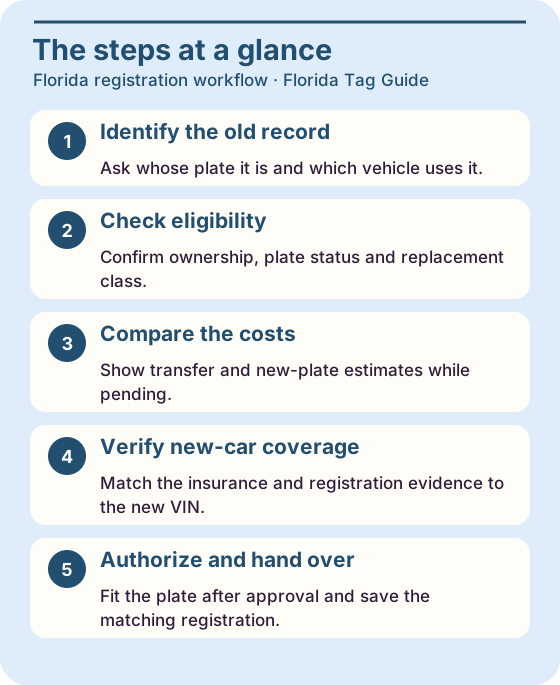
Read the steps as text
- Identify the old record Ask whose plate it is and which vehicle uses it.
- Check eligibility Confirm ownership, plate status and replacement class.
- Compare the costs Show transfer and new-plate estimates while pending.
- Verify new-car coverage Match the insurance and registration evidence to the new VIN.
- Authorize and hand over Fit the plate after approval and save the matching registration.
Confirm coverage for the replacement vehicle
An insurance policy for the source vehicle and proof for the replacement deserve different checks. FLHSMV’s verification guidance addresses coverage for the vehicle to which the plate is transferred. Have the buyer confirm the insurer’s effective date and the precise VIN being insured. A correct policy for the wrong car leaves the vehicle you are delivering unresolved. Ask for the evidence the dealer channel accepts and resolve any mismatch before handover.
Schedule the handoff around when the buyer’s agent can issue usable proof, especially on evenings and weekends. A buyer can speak directly with their insurer rather than providing insurance credentials to sales staff. If the record is not ready, explain which document is pending, who is waiting for it and when the dealership can review it again. Cover temporary registration and insurance separately when the customer asks when they can drive away.
If the buyer keeps the old car for an extra day, have them verify with the insurer and the applicable agency how to keep each vehicle properly covered and registered during the overlap. For example, a plate taken from an old car to a new one does not automatically give the outgoing car a legal on-road registration plan. A short written handoff prevents the buyer from interpreting a generic “all set” as permission for both vehicles to drive.
Record the authorized match before the vehicle leaves
When the dealer is fitting the customer’s eligible Florida metal plate to a replacement vehicle, follow the applicable electronic temporary transfer procedure through ETR or use an authorized tax collector or license plate agency. The approved transaction provides registration evidence tied to the replacement vehicle. Verify the plate number and VIN against the actual car before handing over the keys or instructing anyone to fit the plate.
If the system declines the transfer, identify why the official record did not match. FLHSMV’s transfer procedure gives routes through an authorized office or an eligible temporary issuance when the plate is not available or the transfer is not authorized by ETR. Temporary issuance has its own rules. A member of staff should confirm that a particular temporary tag is available for that transaction before suggesting it as a fallback. Document which route the authorized provider recommended.
The clerk who handles the permanent title still needs their own submission and confirmation. A successful temporary transfer does not finish title processing. Reference the dealer title and registration checklist at handoff for ownership paperwork, the applicable filing deadline and the distinction between the two systems. The dealer and buyer should have the appropriate registration evidence for the approved delivery path.
Show two budgets while eligibility is unresolved
At the quote desk, open the passenger-car estimator and use the facts you know. For the hypothetical customer with an eligible active Florida plate and a same-class replacement, choose the transfer scenario. For a customer without a verified record, run a new-plate scenario as a separate estimate. Do not represent an uncertain plate as active to produce a lower price. If the customer provides evidence of a prior record or an expired registration, use the appropriate comparison and ask the clerk to verify the correct treatment.
Let the customer see each amount in context. One line can say “eligible transfer, pending official verification.” A second can say “new plate, if the record is unavailable or ineligible.” Use identical facts for the rest of the estimate when you want to show what changed. A change to the purchase price or registration county can otherwise hide the difference in the tag decision. See the out-the-door price checklist for how to present these line items.
Repeat this check for phone leads and returning customers. Explain what the buyer can look up or bring without sending an ID or full registration document to a general inbox. Use the registration estimator for preparation and your approved dealer system for the final amount. The public calculator cannot verify an owner, search a tag or activate a transfer.
Use a delivery sign-off that another employee can verify
Put the physical plate number, replacement VIN and result of the authorized registration action on the delivery record. The salesperson can then confirm the plate mounted on the vehicle is the one the clerk cleared. Explain which document the customer should keep in the car and where they can direct a question about the permanent title. If the old vehicle remains on site, make clear who handles its plate and which records are still open.
A sample training exercise helps find gaps. Customer A traded an eligible same-class vehicle and brought the current Florida plate, so staff verify a successful authorized transfer and match the issued record to the replacement. Customer B wants to keep driving the prior car for two more weeks, so the sales estimate remains conditional while the title desk works out the lawful registration options. Customer C brought a plate linked to a different registrant, so the desk confirms legal ownership and eligibility before quoting a specific transfer. All three are normal customer requests, yet their paperwork and delivery decisions differ.
Look at the cases you corrected last month and assign each one a cause: owner mismatch, outdated proof, wrong plate scenario or unresolved vehicle class. If the same issue recurs, move the question earlier in the sales intake. A tool bookmarked beside the intake gives staff a regular way to compare scenarios. Consistency comes from recording the verified choice before delivery rather than memorizing a single transfer price.
- Check ownership, vehicle class and verified plate status.
- Record the official ETR or office transfer result.
- Match the registration to the metal plate and replacement VIN.
- Keep title filing open until its own confirmation arrives.

Correct a disagreement before changing a confirmed registration
If the customer finds the wrong vehicle or tag on the paperwork after delivery, gather the relevant registration reference and the vehicle identities through your approved contact method. Ask the authorized filing channel to identify which record is on file and its prescribed correction process. Explain what the customer should do pending the agency’s answer rather than moving metal between vehicles to reconcile the paperwork by hand. Keep the date, person responsible and customer communication visible in the deal record.
After correction, compare the corrected registration with the original title filing and the sales quote. The quote may need to show a refundable or additional charge, and the filing may need a corresponding confirmation. Assign each action to the relevant desk, then confirm the customer has the final documents for their vehicle. A self-contained correction record is useful when someone returns for a later trade and asks whether their plate is eligible again.
For training, compare a customer who has the correct metal plate but a registration confirmation for a different VIN with a customer whose documents are correct but whose intended plate is missing. In the first case, fix the record and confirm the authorized match. In the second, establish the issuance or replacement path before fitting any plate. Two different defects can produce the same complaint at pickup. The written intake lets staff remedy the actual issue instead of guessing at a fee.
Frequently asked questions
Can a dealer transfer a Florida plate to a new owner?
Some changes in ownership have distinct procedures. For an ordinary replacement, verify the registered owner and the new vehicle’s title ownership under the applicable transfer rules before quoting a transfer.
Can the buyer put the old plate on the replacement immediately?
Only after the applicable authorized registration action. The plate displayed on the replacement must match the vehicle’s registration record.
Can you estimate fees without the physical plate?
Yes, as an explicitly conditional estimate. The clerk still needs to verify the Florida record and determine what kind of issuance or transfer is available.
Is an expired tag always equivalent to an active transfer?
Expiry can affect renewal and other charges. Verify the eligible record and then price the appropriate renewal and transfer or issuance scenario.
Does a temporary transfer finish permanent title paperwork?
The temporary registration path and permanent title filing need separate confirmations through the dealer’s approved procedures.
Official sources
- Florida Statutes § 320.0609 on transferring a registration and license plate
- FLHSMV license plate transfer procedure RS-05
- FLHSMV initial registration fee procedure RS-30
- FLHSMV insurance verification procedure RS-36
- FLHSMV dealer handbook on delivery and registration
- Orange County Tax Collector vehicle sales and plate guidance